From transformers and switchgear to ring main units, substations, circuit breakers and smart components, Jubang provides integrated product support for power distribution projects.
Discover Jubang’s strengths in technology R&D, quality testing and smart manufacturing, supporting reliable electrical equipment and efficient power distribution solutions for global customers.
From technical consultation and OEM/ODM customization to EPC support, smart O&M, delivery documentation and after-sales service, Jubang supports your project at every stage.
Explore Jubang Group’s development history, intelligent manufacturing base, R&D platforms, CNAS-accredited laboratory and global project service capabilities.
Residual Current Circuit Breaker: RCCB, RCD and RCBO Explained
Release Time: 2026-11-10
A residual current circuit breaker without integral overcurrent protection, or RCCB, responds to residual-current conditions but does not itself provide overload and short-circuit protection. RCD is the broader residual-current device term. An RCBO combines residual-current protection with integral overcurrent protection.
Those names matter when reading a specification. Two products can both offer residual-current detection while having different functions, current ratings and application conditions.
Residual current circuit breaker, RCD and RCBO: the distinction
Start with the functions included in the device, rather than the shape of its enclosure. The table describes terminology; it does not establish that products in the same row are interchangeable.
Term
Meaning
Overcurrent question
RCD
Broad term for residual-current devices
Check the actual device category and functions
RCCB
Residual-current operated circuit breaker without integral overcurrent protection
Separate overload/short-circuit protection is required as part of the arrangement
RCBO
Residual-current operated circuit breaker with integral overcurrent protection
Residual-current and overcurrent functions are combined
Industrial breaker incorporating a residual-current function
A different equipment category that can include additional protective functions
Read its actual product classification and protection description
The last row is useful because “earth leakage” is a function description that can appear on different kinds of equipment. It does not automatically make the product a plain RCCB.
How residual-current sensing works
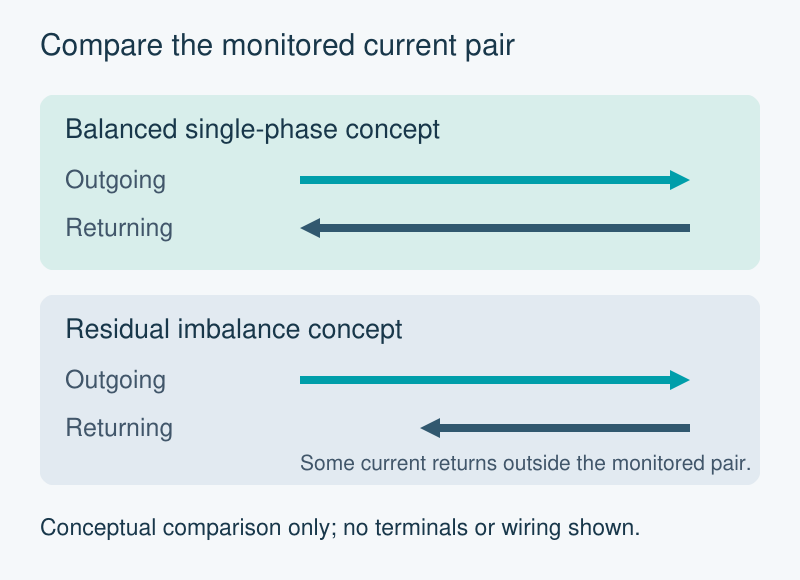
In a simple single-phase explanation, the monitored line current goes towards the load and the monitored neutral current returns. When these currents balance, their opposing magnetic effects in the sensing core cancel. If some current returns outside that monitored pair, an imbalance can be detected and used to initiate tripping under the device’s operating conditions.
The device senses the imbalance in the monitored conductors; it does not need to measure the unintended return path directly. This is a different question from whether the load current is too large. A current-balance explanation therefore cannot be used as proof that an RCCB also provides overload protection.
Conceptual comparison of relative current magnitudes in a single-phase example. Arrow lengths are illustrative; this is not a wiring diagram, a fixed AC current direction or a trip-threshold scale.
Detection also does not identify every possible cause of an operation. A residual-current event needs an assessment of the circuit and connected equipment. Resetting or changing a device does not establish what produced the imbalance.
Two current ratings answer different questions
The rated current, In, concerns the current the RCCB is intended to carry under its declared conditions. The rated residual operating current, IΔn, concerns the residual-current operating characteristic. One is not a substitute for the other.
In particular, the carrying-current value is not an overload trip setting for a plain RCCB. A buyer who reads only the large ampere marking may miss the need for the separate overcurrent-protection arrangement. Conversely, a residual-current sensitivity value does not establish the load-carrying capacity.
For a useful technical comparison, record both fields with the exact device reference. Also keep the poles, voltage, residual-current type and any applicable delay or coordination information attached to that reference. An isolated number copied from a front label is an incomplete specification.
Waveform suitability and the test button have limits
Residual-current devices are offered with different response types. Suitability depends on the residual-current waveform associated with the connected equipment and the selected device’s declared capability. Do not assume that every RCD responds to every waveform because it has the same nominal sensitivity.
For a purchase enquiry, obtain the connected-equipment requirements and the proposed device’s type information. That is more useful than choosing a type from a generic application slogan. This article does not assign a device type to a particular installation.
The test button checks the device through its incorporated test circuit. It does not verify the complete condition of the installation’s protective conductor or earth electrode. The manufacturer’s instructions and applicable inspection arrangements determine the necessary checks; a successful button operation should not be treated as a complete installation assessment.
Keep the JUBANG product classification accurate
The published JUBANG GTM6L earth-leakage circuit-breaker family describes overload, short-circuit and undervoltage functions as well as earth-leakage protection. It is an earth-leakage molded-case breaker, not an example of a plain RCCB without overcurrent protection.
When discussing a project, name the required device category and the functions it must include. Ask for the exact offered model, its current/residual-current data and the associated protection documentation. That lets the enquiry distinguish a residual-current function from the complete protective device being supplied.
Products are exported to more than 100 countries and regions such as Africa, the Middle East, and the United Kingdom and Europe. It is a leading manufacturer of power distribution equipment in China.

 JUBANG