From transformers and switchgear to ring main units, substations, circuit breakers and smart components, Jubang provides integrated product support for power distribution projects.
Discover Jubang’s strengths in technology R&D, quality testing and smart manufacturing, supporting reliable electrical equipment and efficient power distribution solutions for global customers.
From technical consultation and OEM/ODM customization to EPC support, smart O&M, delivery documentation and after-sales service, Jubang supports your project at every stage.
Explore Jubang Group’s development history, intelligent manufacturing base, R&D platforms, CNAS-accredited laboratory and global project service capabilities.
Transformer Inrush Current: Causes and Protection Data to Request
Release Time: 2026-11-10
Transformer inrush current is the transient magnetizing current drawn during energization. It can occur with little or no secondary load and can be much larger than the steady excitation current. Its magnitude and waveform depend on the transformer and energization conditions, so a single “typical” current multiple is not a complete procurement input.
The practical question is which inrush description applies to the offered transformer and the project’s energization cases, and how that information will enter the protection review.
Why transformer inrush current occurs
Applying voltage establishes magnetic flux in the core. The core may already retain residual flux from a previous energization. The initial flux excursion, combined with that residual condition, can push the magnetic operating point into saturation and produce a large magnetizing current.
The switching point on the voltage waveform matters because the flux trajectory depends on the applied voltage over time. Source conditions also affect the resulting current. Consequently, another energization of the same transformer need not reproduce an identical event.
This differs from the steady no-load current listed in a catalogue. It also differs from the normal load current delivered after the system settles. A steady-state column cannot be relabelled as an energization envelope.
Inrush is not necessarily a fault, but an operation occurring at energization should not automatically be dismissed as normal inrush either. The event information and protection behaviour require review. A generic illustration cannot diagnose the cause of a particular trip.
Request data that can actually be compared
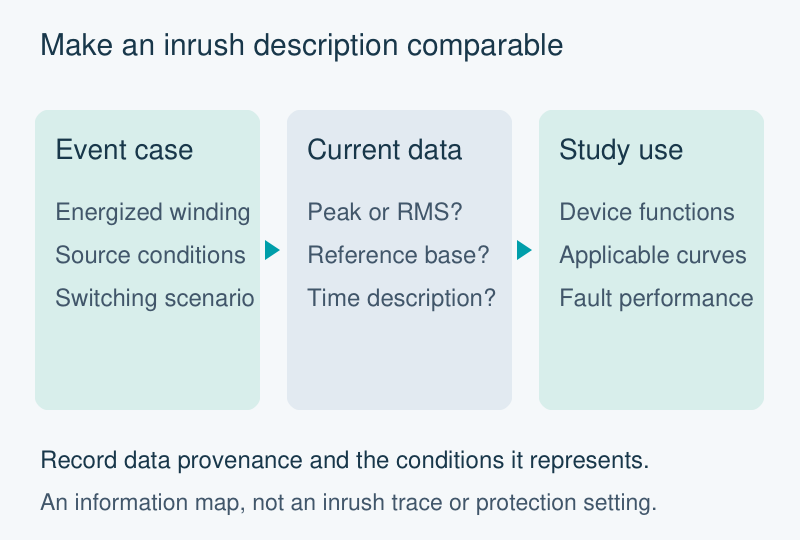
A useful inrush statement defines the event and the current quantity together. “Several times rated current” leaves open whether the figure is a peak, an RMS quantity, a phase-specific result or a multiple based on a different winding’s current.
Original data-request map. It contains no measured or simulated current trace, and it specifies no protective-device setting.
Requested field
Clarification to obtain
Why the distinction matters
Energization case
Which winding is energized, with what source arrangement and switching scenario?
An event description must correspond to the case being studied
Current definition
Peak, RMS or another stated quantity; phase-specific or combined presentation
Different current quantities cannot be compared as though they were the same
Reference base
Which rated current, winding and voltage define any per-unit value or multiplier?
A multiplier without its base is ambiguous
Time description
What interval, decay description or envelope accompanies the current value?
A peak alone does not describe the entire event
Provenance and conditions
Calculation, test or other source; assumptions and limits stated
The reviewer needs to know what the information represents
These are information requests, not additional ratings invented by the buyer. If a supplier has only a preliminary estimate, label it accordingly. A clearly bounded estimate is more useful than an apparently exact number with no event definition.
Connect the information to protection functions
The protection review needs to consider energization behaviour while retaining the required response to genuine faults. Raising a pickup or adding a delay solely to stop an unwanted operation can change fault performance. This is a study question, not a generic adjustment to copy from an article.
Transformer differential protection adds another distinction. Magnetizing current during energization can contribute to the differential signal. Harmonic-based methods are used in some protection schemes, but technical research documents inrush cases with low second-harmonic content. The presence or absence of one harmonic is therefore not an infallible universal event test.
The relevant reviewer needs the actual protective-device functions and their applicable documentation. An offered breaker curve, fuse characteristic or relay description should be assessed against the defined event and fault requirements. The transformer catalogue and the protective-device catalogue answer different parts of that review.
Separate a new-equipment enquiry from a trip investigation
For a new project, identify the planned energization cases and who supplies the transformer data, source information and protection-study inputs. Record unresolved assumptions so the final review can revisit them when the offered configuration is known.
For an existing operation, retain the available event record, equipment identification, source arrangement and protection indications. Those records are more informative than a statement that the trip happened “at startup.” They allow the responsible engineer to compare the observed event with the equipment and protection information.
In either case, keep actual measurements, calculated envelopes and general educational examples distinct. A generic current shape is not evidence that the project’s event had the same peak, duration or harmonic content.
Ask for the offered transformer’s data
The published JUBANG 35 kV oil-immersed transformer family provides a starting point for a model-specific discussion. Its public steady-state no-load-current information does not supply a verified inrush envelope for a project.
Identify the proposed unit and energization case, then request the available inrush information with its current definitions, assumptions and provenance. That gives the protection team an assessable input and makes remaining data gaps visible before the equipment decision is finalized.
Products are exported to more than 100 countries and regions such as Africa, the Middle East, and the United Kingdom and Europe. It is a leading manufacturer of power distribution equipment in China.

 JUBANG