From transformers and switchgear to ring main units, substations, circuit breakers and smart components, Jubang provides integrated product support for power distribution projects.
Discover Jubang’s strengths in technology R&D, quality testing and smart manufacturing, supporting reliable electrical equipment and efficient power distribution solutions for global customers.
From technical consultation and OEM/ODM customization to EPC support, smart O&M, delivery documentation and after-sales service, Jubang supports your project at every stage.
Explore Jubang Group’s development history, intelligent manufacturing base, R&D platforms, CNAS-accredited laboratory and global project service capabilities.
Miniature Circuit Breaker: How It Works and What B, C and D Mean
Release Time: 2026-11-10
A miniature circuit breaker (MCB) is an overcurrent protective device with contacts that open when its trip system operates. In a thermal-magnetic MCB, the thermal and magnetic response regions address different overcurrent conditions. The B, C or D letter describes a characteristic; it does not replace the rated current, voltage or breaking capacity.
Reading those fields separately is the key to understanding a miniature circuit breaker. A curve letter alone cannot select a device or establish that a replacement is suitable.
How a miniature circuit breaker responds
With the contacts closed, current passes through the device. The thermal response addresses sustained overload conditions and has a time-dependent characteristic. The magnetic response addresses higher overcurrents in a different region of the characteristic. Operation causes the contacts to open, interrupting current within the device’s declared capability.
The full manufacturer time-current curve shows how those response regions relate. A short label such as “C curve” does not give every operating time, environmental condition or tolerance represented in that curve. It is particularly important not to confuse the magnetic region with the entire overload response.
What B, C and D mean in a published AC example
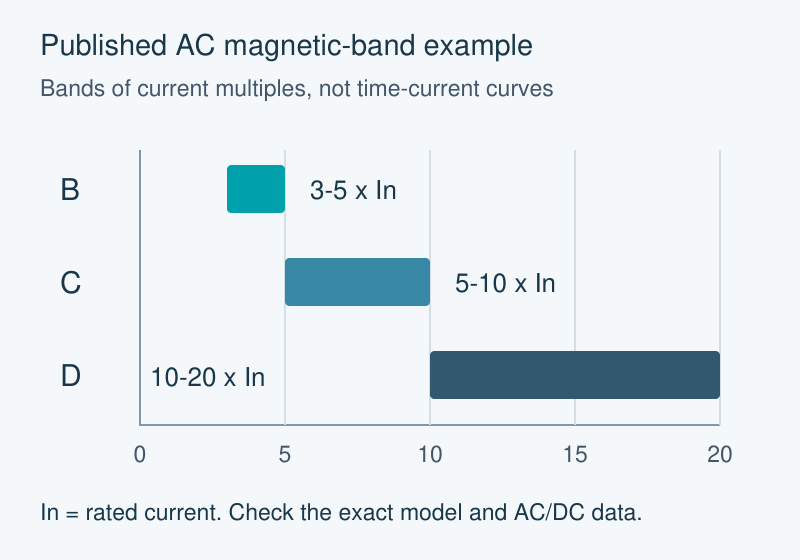
The cited technical catalogue provides the following AC example for its stated product family. In means rated current. These are magnetic-response bands expressed as multiples of In, not single exact trip currents and not universal values for every device sold with the same letter.
Characteristic
Cited AC example band
What the number does not tell you
B
3–5 × In
The complete thermal response or a breaking-capacity rating
C
5–10 × In
One guaranteed current and time at which every C device trips
D
10–20 × In
A universal value for all product families or DC applications
Original visualization of the cited catalogue’s AC example. The horizontal axis is current divided by rated current. This is not a time-current curve or a measured JUBANG test result.
The position of the band explains why a higher letter can accommodate a different high-current transient characteristic. It does not prove that the device is appropriate for a particular motor, transformer or lighting circuit. The exact load and circuit conditions still have to be matched to the full product data.
Use the stated AC/DC basis as well. The same catalogue gives different magnetic-region information for DC operation. A familiar AC band should not be transferred to a DC circuit simply because the front of the device looks similar.
Read a label without turning it into a setting
As a hypothetical arithmetic example, assume a 16 A device uses the illustrated C band. Multiplying 16 A by 5 and 10 gives 80 A and 160 A. That calculation translates the band; it does not identify one exact trip point, prescribe an operating delay or describe an offered JUBANG model.
There are three separate questions here. The 16 A value identifies the assumed rated current. The C characteristic concerns the response profile. Breaking capacity concerns the interruption duty at its declared conditions. Treating 80 A or 160 A as the device’s breaking capacity would mix different quantities.
A practical reading note records the complete catalogue reference, rated current, characteristic, operating voltage, breaking capacity and pole arrangement. If one of those fields is missing, the curve letter cannot fill the gap.
Why changing the letter is not a generic fix
Repeated operation needs a cause assessment. Changing from B to C or D to avoid tripping also changes the protective characteristic. It should not be treated as a routine solution without reviewing the circuit and the selected device data.
Likewise, moving to a higher current rating is a different change from choosing a different curve. Neither follows automatically from a nuisance-trip description. The protection review must address both the load behaviour and the required fault response, rather than only the event the operator wants to avoid.
For procurement, ask for the actual time-current data and the conditions attached to it. A small selection table or a generic internet chart is useful for orientation, but it cannot substitute for a model-specific characteristic and the engineering assessment of the circuit.
What a JUBANG MCB enquiry can establish
The published JUBANG OEM/ODM scope includes miniature circuit breakers and discussions of protection characteristics, rated current, breaking capacity and accessories. That is a service-scope statement, not a verified standalone model specification.
Provide the required poles, voltage, current and protection-characteristic information, together with the application conditions. Request the proposed model’s datasheet and curves before treating any example band in this article as a device-specific answer.
Products are exported to more than 100 countries and regions such as Africa, the Middle East, and the United Kingdom and Europe. It is a leading manufacturer of power distribution equipment in China.

 JUBANG