From transformers and switchgear to ring main units, substations, circuit breakers and smart components, Jubang provides integrated product support for power distribution projects.
Discover Jubang’s strengths in technology R&D, quality testing and smart manufacturing, supporting reliable electrical equipment and efficient power distribution solutions for global customers.
From technical consultation and OEM/ODM customization to EPC support, smart O&M, delivery documentation and after-sales service, Jubang supports your project at every stage.
Explore Jubang Group’s development history, intelligent manufacturing base, R&D platforms, CNAS-accredited laboratory and global project service capabilities.
Fuse vs Circuit Breaker: Protection, Resetting and Selection Differences
Release Time: 2026-11-08
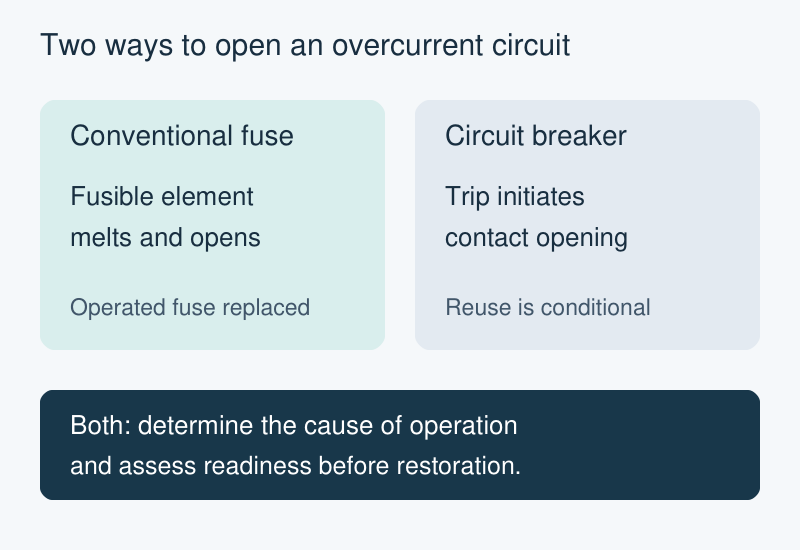
The central difference in fuse vs circuit breaker protection is how the device opens the circuit. A conventional fuse operates by melting its fusible element and must then be replaced. A circuit breaker opens contacts through a trip mechanism and may be reusable after the event, subject to its condition and the manufacturer’s instructions.
That difference affects service planning, but it does not identify a universal winner. Selection also depends on voltage, available fault duty, the required time-current characteristic and coordination with other protective devices. Two devices carrying the same ampere rating can behave differently.
What happens when each device operates?
A conventional power fuse combines the current path with a fusible element. Operation permanently opens that element. Interruption also involves clearing the resulting internal arc: melting alone is not a complete description of the fuse’s protective duty.
A circuit breaker separates the sensing/tripping function from the contact mechanism. Depending on the device, a thermal-magnetic or electronic trip system initiates opening. The available protection and diagnostic functions depend on the selected breaker, rather than on the word “breaker” alone.
Two operating concepts, not a speed comparison. This article concerns conventional power-circuit fuses, not resettable PTC components.
Fuse vs circuit breaker: compare the evidence that matters
A useful comparison starts by making the electrical conditions consistent. The table separates questions that are often bundled into a single claim such as “better protection.” Each row needs evidence for the exact devices under consideration.
Comparison question
Fuse evidence
Circuit-breaker evidence
What normal current can it carry?
Rated current and applicable environmental conditions
Rated current, configuration and applicable conditions
Can it interrupt the required fault duty?
Interrupting rating at the relevant AC or DC voltage
Declared breaking duty at the relevant voltage
How does it respond across overcurrents?
Time-current data identifying the characteristic shown
Trip curves and applicable settings or fixed characteristic
Does it limit fault let-through?
Current-limiting range and published let-through data
Current-limiting capability and published data for that device, if offered
How does it work with adjacent protection?
Coordination information for the selected upstream/downstream combination
Coordination information for the selected devices and settings
This approach prevents an ampere rating from doing work it cannot do. Carrying normal load and interrupting a short circuit are different duties. A voltage rating also matters during interruption; a physically similar device is not automatically suitable for another circuit.
Likewise, a current-limiting claim has a defined operating range. It is not a promise of the same let-through at every overcurrent. Compare the manufacturer’s curves and conditions, rather than assuming every fuse is faster than every breaker. A selected combination may have useful coordination or tested-combination evidence, but that evidence cannot be transferred to an unspecified substitute.
Resetting is a capability, not a restoration decision
After a protective device operates, the first question is why it operated. Replacing a fuse or moving a breaker handle does not remove the original circuit problem. The event and the equipment condition must be evaluated before service is restored.
For a breaker, this means separating the ability to reset its mechanism from suitability for continued use. The selected device’s instructions govern the necessary inspection or evaluation after the event. “Resettable” should not become an assumption that every fault leaves the breaker and connected equipment ready for another energization.
For a fused circuit, the service plan needs the specified replacement and compatible holder information. A spare that looks similar or has the same nominal amperes may differ in voltage duty, characteristic or class. Replacement requirements for a multiphase arrangement also belong to its equipment instructions; they should not be improvised from a generic comparison article.
A practical way to evaluate an offer
Use two passes. First, compare electrical suitability: the circuit conditions, interrupting duty, protective characteristic and coordination evidence. Record an unresolved item against the exact catalogue reference or drawing, so a missing curve is not confused with an unfavourable curve.
Then compare the operating arrangement. Who investigates an operation? Which replacement parts or diagnostic information will be available? What inspection and maintenance instructions accompany the offer? These questions make service convenience assessable without claiming that convenience proves protection performance.
Consider a buyer comparing two feeder proposals with the same normal-current description. One includes only a device name and amperes; the other identifies the voltage duty, curve and coordination documents. The first proposal is still incomplete, regardless of whether its device is a fuse or breaker. The useful next action is to close that evidence gap before comparing restoration logistics or price.
On the breaker side, JUBANG’s GTM1 molded-case circuit-breaker family provides a product starting point. An enquiry should identify the circuit conditions and request the exact offered configuration and protection documents. Its catalogue presence does not establish that it can replace an existing fuse arrangement without an engineering review.
Products are exported to more than 100 countries and regions such as Africa, the Middle East, and the United Kingdom and Europe. It is a leading manufacturer of power distribution equipment in China.

 JUBANG