From transformers and switchgear to ring main units, substations, circuit breakers and smart components, Jubang provides integrated product support for power distribution projects.
Discover Jubang’s strengths in technology R&D, quality testing and smart manufacturing, supporting reliable electrical equipment and efficient power distribution solutions for global customers.
From technical consultation and OEM/ODM customization to EPC support, smart O&M, delivery documentation and after-sales service, Jubang supports your project at every stage.
Explore Jubang Group’s development history, intelligent manufacturing base, R&D platforms, CNAS-accredited laboratory and global project service capabilities.
Wind Farm Substation Corrosion Protection: Enclosure and Component Choices
Release Time: 2026-07-23
Corrosion protection for a wind farm substation starts with classifying the site environment, not with picking a paint. Once the corrosivity of the location is stated under the ISO framework, enclosure materials, coating or galvanizing systems, fasteners, gaskets and ventilation details can all be specified against that classification — and checked against it at the factory and on site.
Wind sites earn the extra care. Many sit on coastlines, ridgelines or open plains where salt, wind-driven moisture and long wetness periods work on every exposed surface, and the substation is expected to stay out there for the life of the project.
Part 1. Why wind farm substations corrode faster
Three environmental factors do most of the damage, and ISO 9223 names them as the key inputs to atmospheric corrosivity: the temperature-humidity complex (expressed as time of wetness), sulfur dioxide pollution and airborne salinity. Wind-farm locations often score high on the first and last of these — persistent wind carries chloride inland from open water, and exposed terrain extends the hours each year that surfaces stay wet.
Add the operating reality: a wind farm substation is remote, visited rarely, and expected to survive between inspections without a maintenance crew nearby. A protection choice that would be tolerable next to a workshop becomes expensive at the end of an access track.
The wind industry treats this as a structured engineering topic. DNV-RP-0416 is a dedicated recommended practice for corrosion protection of wind turbines; whether and how its approach extends to balance-of-plant equipment is a project decision, but its existence signals the expected rigour.
Part 2. Classify the site before specifying anything
ISO 12944-2 classifies the environments to which steel structures are exposed and defines atmospheric-corrosivity categories — commonly written C1 through CX — based on the mass loss of standard specimens, alongside categories for immersed or buried structures and notes on special corrosion stresses. ISO 9223 supplies the classification, determination and estimation methods behind first-year corrosion rates.
For a tender, the useful output is a stated category with a stated basis. Collect these inputs before anyone names a coating system:
Classification input
What to record
Why it matters
Distance to coast or open water
Measured distance and prevailing wind direction
Chloride deposition drives the category upward
Wetness pattern
Rain, fog, condensation and drying behaviour at the site
Time of wetness is a key ISO 9223 factor
Pollution sources
Industrial plants, traffic, agriculture nearby
Sulfur dioxide and other deposits change corrosion rates
Terrain and sheltering
Exposure of the substation pad versus sheltered ground
Exposure extends wet hours and salt delivery
Classification decision
The category assigned, by whom, on which standard edition
Every later material and coating decision references it
State the category in the tender rather than shipping the raw observations. A supplier quoting against “coastal-ish, quite windy” will guess; a supplier quoting against a named category with a named basis can be held to it.
Part 3. Enclosure material and coating choices
With a category on paper, the enclosure discussion becomes a comparison instead of a taste debate. Field discussions among engineers repeat three families of options for outdoor electrical enclosures, each with real trade-offs:
Option family
Strengths reported
Cautions reported in field discussions
Coated (painted) steel
Economical; system can be matched to the assigned category
Damage and edge preparation decide real life; repaint needs access
Hot-dip galvanized steel, with or without paint over it
Zinc gives sacrificial protection; specified and tested under ISO 1461
Painting over galvanizing needs surface-preparation care; heavier salt exposure pushes toward more zinc plus a paint system
Stainless steel
Strong pitting resistance in the right grade
Practitioners report pitting under salt accumulation on sheltered, unwashed surfaces, plus heat gain in direct sun
Two habits keep this decision honest. First, specify the system against the assigned category and the applicable standard, and ask the supplier to declare what the quoted enclosure actually carries — material grade, preparation, coating system and the standard each item follows. Second, treat field reports (pitting under salt film, spot-weld attack, coating failure at cut edges) as questions to put to the supplier and a corrosion specialist, not as verdicts against a whole material family.
Enclosure families for wind and renewable duty are collected under the prefabricated substation category; the corrosion documentation for any specific unit still comes from its current model documentation.
Part 4. Components that fail first
Enclosure panels rarely lead the failure list. Practitioner threads on outdoor switchboards in salt-heavy environments keep returning to the same small parts:
Component
Field-reported weak point
What to specify or ask
Fasteners and hinges
Corrosion and seized threads on dissimilar or unprotected metals
Fastener and hinge material family, isolation against galvanic pairs
Gaskets and door seals
Sealing loss lets salt-laden moisture sit inside seams
Gasket approach, replaceability, seam design
Spot welds and cut edges
Attack starts where coating is thinnest
Edge treatment and weld protection in the coating declaration
Ventilation openings
Airflow paths admit salt and moisture
The ventilation concept versus the ingress protection intent, stated together
Base and ground interface
Splash, standing water and buried-edge attack
Base material, drainage and the interface to the foundation
Ventilation deserves its own sentence in the specification. A ventilated enclosure and a tightly sealed one are different corrosion environments inside, and the balance between cooling airflow and ingress protection is a stated design decision for prefabricated assemblies under IEC 62271-202 — request the intended arrangement and its classification for the quoted unit rather than assuming either extreme.
Part 5. Equipment inside the enclosure
Corrosion protection does not stop at the skin. The step-up transformer inside a wind farm substation has its own standard context: IEC/IEEE 60076-16 applies to dry-type and liquid-immersed transformers for wind turbine step-up application with winding highest voltage up to and including 72.5 kV.
Its stated scope covers the transformer connecting a turbine to the collection system — not the one connecting several turbines to a network. Confirm which transformers in the project fall under that scope and which follow the general power-transformer standards.
Radiators, tank surfaces, bushing hardware, terminal boxes and cable glands all see the same salt air as the enclosure. Ask the supplier how each externally exposed component of the transformer and switchgear is protected, and where that is documented. The application background for this product class is covered in the advantages of wind power combined transformers.
Part 6. Inspection, maintenance and documentation
A corrosion specification only pays off if someone can inspect against it. Build the paperwork side into the order:
A material and coating declaration for the quoted unit — material grades, preparation, coating or galvanizing system, and the standard each follows.
Test or verification evidence as applicable to the declared system.
Inspection guidance: what to check, where the vulnerable details sit, and what early attack looks like.
A maintenance plan skeleton: cleaning, touch-up rules, gasket replacement expectations and record-keeping.
Fit boundary: this article suits buyers specifying corrosion protection for onshore wind-farm substation equipment, including coastal-adjacent sites. It is not a coating-system design, a corrosivity survey, an offshore structural corrosion design, or a source of thickness, test-duration or acceptance values — those belong to the project’s corrosion specialist and the applicable standards. If the site may fall under marine or offshore rules, resolve that classification first.
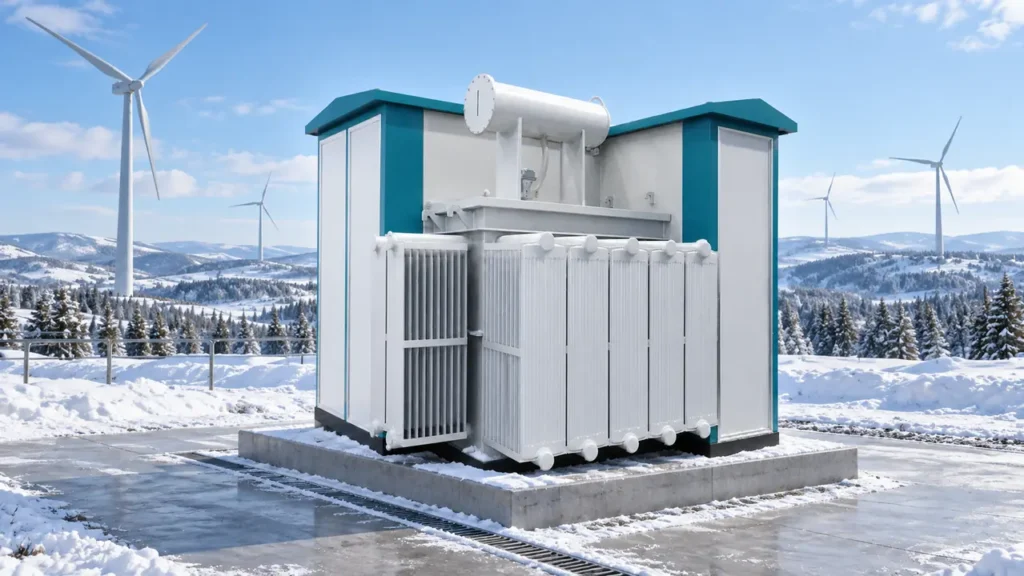
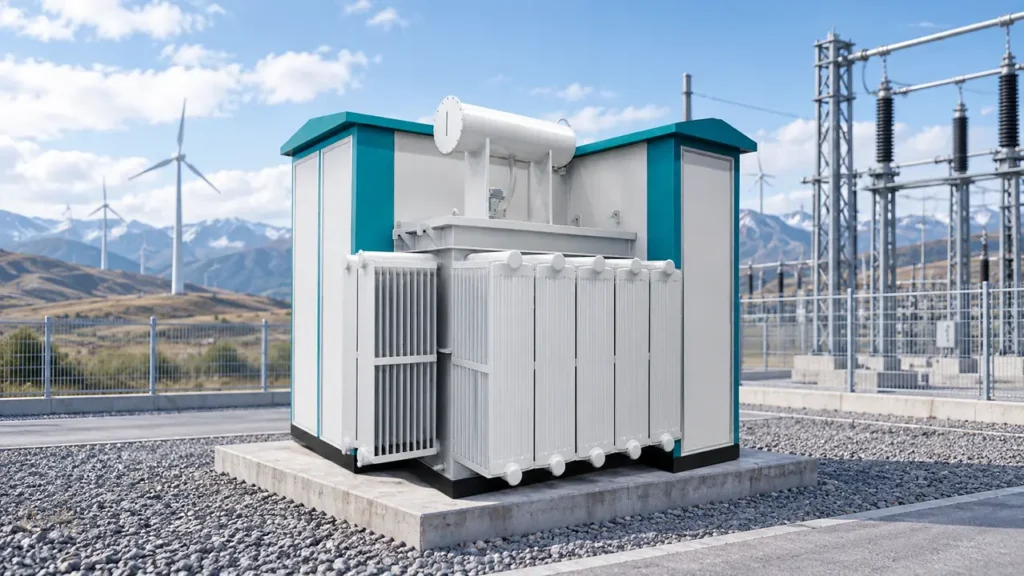
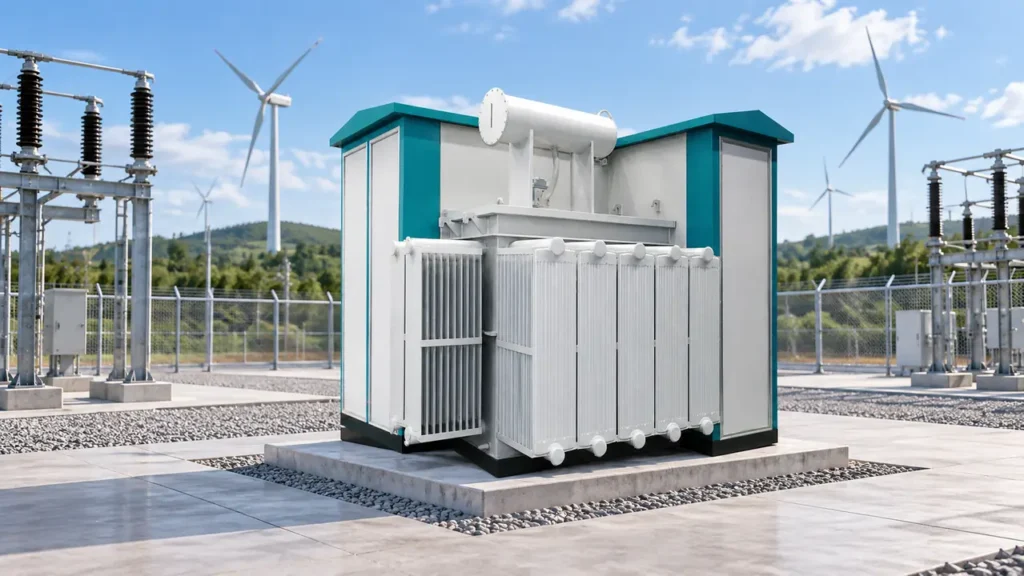
Both are product-family starting points: enclosure material, coating system and corrosion documentation for a quoted unit come from current JUBANG model documentation and project review, not from a category page. The PV variant of the family is deliberately not recommended here because its interface duty follows solar inverters, and storage booster cabins serve a different conversion duty.
Site location and environment description: distance to coast or open water, pollution sources, wetness pattern, and any measured or estimated corrosivity information.
The corrosivity category the project assigns, with the standard edition and who assigned it.
Enclosure expectations: material family and the coating or galvanizing system expectation stated per the applicable standard.
Component expectations: fastener and hinge materials, gasket approach, and the ventilation versus ingress-protection intent.
Equipment duty: wind turbine step-up interface data and which transformers fall under the wind-turbine transformer standard’s scope.
Documentation required: material and coating declaration, verification evidence as applicable, inspection and maintenance guidance.
Commercial data: quantity, delivery location, target dates and the commercial-terms basis.
Send the package through contact us for an engineering review against current product documentation.
FAQ
Which corrosivity category applies to a wind farm substation site?
The one the project assigns after evaluating the site under the ISO framework — distance to salt water, wetness pattern and pollution sources drive it. No category can be assumed from the project type alone; record the assigned category and its basis in the tender.
Is hot-dip galvanizing enough for a coastal substation enclosure?
Sometimes, and sometimes only as the first layer. Galvanized coatings are specified and tested under ISO 1461, and practitioners push toward more zinc or a paint system over the galvanizing as salt exposure rises. Decide against the assigned category with the supplier’s declared system, not by habit.
Can stainless steel enclosures corrode at coastal sites?
Field reports say yes in specific conditions — salt accumulating on sheltered, unwashed surfaces can pit some grades. Grade selection, surface finish, washing by rain and the site’s salt delivery all matter; put the question to the supplier and a corrosion specialist for the specific site.
Which parts of a box substation corrode first?
Field discussions point at the small parts: fasteners, hinges, gaskets and seams, spot welds and cut edges, ventilation paths and the base interface. Specify these details explicitly; the panels usually outlast them.
Do offshore corrosion rules apply to onshore wind substations?
Not automatically. Offshore and marine structures follow their own frameworks, while onshore equipment is normally specified against atmospheric corrosivity categories. Sites at the boundary — splash zones, harbours, very near shorelines — need the project engineer to state which framework governs.
What corrosion documentation should a tender require?
A material and coating declaration for the quoted unit, verification evidence applicable to the declared system, inspection guidance and a maintenance plan skeleton. Without the declaration, later inspection has nothing to check against.
What should a wind farm substation RFQ say about corrosion protection?
State the assigned corrosivity category and its basis, the enclosure material and coating-system expectations per the applicable standard, component-level expectations, the equipment duty, the documentation list and the commercial data. The supplier then declares what the quoted unit carries against each line.
Products are exported to more than 100 countries and regions such as Africa, the Middle East, and the United Kingdom and Europe. It is a leading manufacturer of power distribution equipment in China.

 JUBANG