From transformers and switchgear to ring main units, substations, circuit breakers and smart components, Jubang provides integrated product support for power distribution projects.
Discover Jubang’s strengths in technology R&D, quality testing and smart manufacturing, supporting reliable electrical equipment and efficient power distribution solutions for global customers.
From technical consultation and OEM/ODM customization to EPC support, smart O&M, delivery documentation and after-sales service, Jubang supports your project at every stage.
Explore Jubang Group’s development history, intelligent manufacturing base, R&D platforms, CNAS-accredited laboratory and global project service capabilities.
Prefabricated Substation Transportation Limits: Dimensions, Weight and Lifting
Release Time: 2026-07-24
No universal size or weight limit exists for a prefabricated substation. The practical limit is the intersection of three things: the unit’s factory data (dimensions, transport mass, centre of gravity, lifting points), the constraints of the specific route to site, and the handling method chosen for each leg of the journey. A unit that ships easily to one project can be undeliverable to another.
Transport therefore belongs at the start of procurement, not the end. This guide covers the data to request from the factory, the route and permit work, the container-versus-breakbulk decision, lifting at site, and the transport lines an RFQ should carry.
Part 1. Why transport limits shape the unit you can buy
Buyers choose a prefabricated substation precisely because it arrives as one factory-assembled, factory-tested unit — the product class covered by IEC 62271-202 within its stated scope. The same integration that saves site work concentrates the delivery risk: the whole enclosure, with its transformer and switchgear inside, must travel as one piece.
Practitioners who move heavy electrical equipment give consistent advice: involve the transport specialist early, because constraints can reach back into the equipment design itself, and permits cap what can move as a single unit. Choosing between one large unit and two smaller ones, or between enclosure arrangements in a prefabricated substation family, is partly a transport decision.
Order of operations matters. Confirm the deliverable envelope first, then configure the electrical scope inside it — reversing that order is how projects end up re-engineering a unit that cannot reach its foundation.
Part 2. The factory data that defines the envelope
Every transport conversation starts with the model outline drawing for the quoted configuration. Ask for it early and check that it carries the full data pack:
Factory data item
Why it matters
Common gap
Overall transport dimensions
Decides container fit, road clearances and escort questions
Catalogue dimensions quoted instead of the as-shipped transport envelope with packing
Transport mass
Drives trailer, permit, crane and foundation-access decisions
Operating mass and transport mass confused
Centre of gravity
Governs securing, trailer positioning and lift balance
Missing from drawings until requested
Lifting points
Defines the approved lifting method and rigging geometry
Assumed instead of confirmed from the drawing
Packing and protection description
Determines securing method and receiving checks
Packing decided late, after freight is booked
Shipping-aware factories treat openings, supports and seals for transport as engineering items, not packaging afterthoughts. Ask how the quoted unit is prepared for its journey — what is removed, what is braced, and what must be refitted at site — and where that is written down.
Part 3. Route checks and permits
Between factory and foundation sits a route with physical and legal constraints: road widths and turning geometry, overhead clearances, bridge and culvert capacities, gate and site-access dimensions, and the permit regime of every jurisdiction crossed. None of that is visible from a product page.
Documented heavy moves show what serious route work looks like. In one published utility case, the delivery team identified candidate routes, ran structural analyses of bridges and culverts along them, and prepared an approved traffic management plan before the authority issued the movement permit — engineering work, not paperwork. The scale differs by project; the sequence does not.
Allocate the route work explicitly:
Who surveys the route and confirms the critical dimensions against the unit’s envelope.
Who applies for transport permits, and in which jurisdictions.
Who checks the last kilometre — site gates, internal roads, turning space and the ground the crane will stand on.
Who owns weather, escort and timing constraints for the move itself.
The site end of this question connects to layout planning: foundation position and access are fixed long before delivery day, as covered in prefabricated substation layout and access.
Part 4. Container, flat rack or breakbulk
For export projects, the first fork is whether the unit travels inside a standardized container envelope or outside it. Series 1 freight containers are classified with standardized external dimensions and ratings under ISO 668 — a fixed constraint the unit either fits or does not, once packing is included.
Mode
Where it fits
What to verify
Standard container
Units whose as-packed envelope and mass sit within the chosen container type
Door and internal dimensions against the packed unit; securing arrangement inside
Flat rack / open top
Units that exceed closed-container envelopes but still suit container handling chains
Overwidth/overheight handling at each port and leg; securing and weather protection
Breakbulk / road trailer
Units outside container logistics entirely
Trailer type, route permits, lifting at each transfer point
Whichever mode wins, packing and cargo securing follow recognized practice: the IMO/ILO/UNECE CTU Code is the joint code of practice for packing cargo transport units across sea and land transport, and its full text covers securing and load distribution for the whole intermodal chain, including those who receive and unpack the unit.
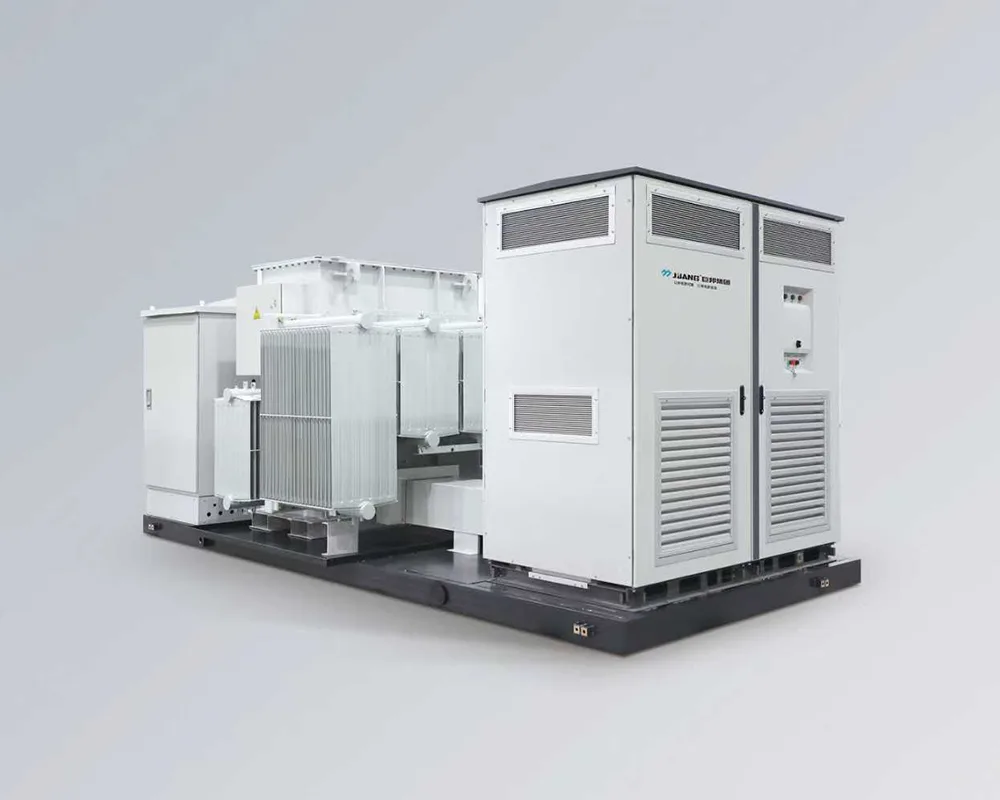
Skid-mounted integrated machines illustrate why the mode question is model-specific — the same family spans compact box substations and long skid units, as shown in the overview of the European style inverter booster integrated machine.
Part 5. Lifting and offloading at site
Lifting turns drawings into physical risk, so it runs on documents and named roles. The approved lifting method for the unit comes from the factory; everything at site comes from the project’s lifting professionals.
Use only the lifting points or lifting lugs shown on the outline drawing, with the rigging geometry the factory approves — never improvised attachment points.
Match the crane and rigging plan to the verified transport mass and centre of gravity, not to catalogue values.
Confirm the ground the crane stands on, the foundation readiness, and the sequence from trailer to foundation before the unit arrives.
Name the lifting-plan owner and the person authorized to stop the lift.
The bare transformer inside follows its own handling rules when shipped separately — that case is covered in transformer transport, lifting and site receiving. For a prefabricated unit the enclosure and equipment travel together, which is exactly why the factory’s lifting documentation governs.
Part 6. Receiving, records and storage
Receiving practice in OEM material is document-led: start from the manufacturer’s instructions, inspect and record the condition at receipt, retain the shipment records, and check impact indication where such devices are supplied — the Prolec installation and field-testing material sequences receiving this way for power equipment generally.
Make the receiving block concrete in the order:
A packing list to check the delivery against, including loose-shipped items to be refitted.
A condition-recording step — photographs and notes against the packing description — before anything is signed clean.
Instructions for impact indicators where supplied, and the escalation contact if one has triggered.
Storage conditions and duties if installation is delayed, stated by the factory for the quoted unit.
Fit boundary: this article suits buyers planning the delivery of factory-assembled substations and writing the transport lines of an RFQ. It is not a route survey, a lifting plan, a packing design or a source of numeric road, container or crane limits — those belong to the project’s logistics and lifting professionals, local rules and the model documentation. Units at the edge of any envelope need the specialist conversation first.
Part 7. JUBANG product family and RFQ inputs
Within JUBANG’s prefabricated-substation family, the transport review anchors on the model outline drawing of the specific product: the YB□-12 Intelligent Integrated Substation for distribution scopes, and the GTE-YB□ integrated cabin for storage and renewable step-up scopes.
The same family includes skid-mounted inverter booster integrated machines that ship as single factory-assembled units.
These are product-family starting points, not selections. Bare power transformers are deliberately not the recommendation here — their transport case lacks the enclosure-envelope question this article answers — and switching-only boxes serve a different scope. Per-model dimensions, transport mass, centre of gravity and lifting arrangement come from current JUBANG model documentation, requested through the RFQ.
Send these transport lines with the RFQ:
Delivery location and known route constraints: access roads, gates, turning space, overhead obstructions as observed.
A request for the model outline drawing with overall dimensions, transport mass, centre of gravity and lifting-point arrangement for the quoted configuration.
The intended transport-mode question — container, flat rack or breakbulk/road trailer — and who books which leg.
Packing and securing expectations, plus the packing-document list: packing list, markings, securing description.
Offloading ownership: crane or handling equipment, rigging responsibility, foundation-readiness dependency.
Receiving requirements: condition recording, impact indication where supplied, storage conditions if installation is delayed.
Submit the package through the online message form so the review can run against the current model documentation.
FAQ
What are the transport size limits for a prefabricated substation?
There is no universal number. The limit for a given project is set by the unit’s as-shipped envelope and mass from the model outline drawing, the physical and legal constraints of the specific route, and the handling method chosen. Confirm all three together before ordering.
How is a prefabricated substation transported?
As one factory-assembled unit, moved by road trailer and — for export — by sea, either within container logistics or as breakbulk. Packing and securing follow recognized practice for cargo transport units, and the factory’s preparation instructions govern what is removed, braced or refitted.
Can a prefabricated substation ship in a standard container?
Only if the as-packed envelope and mass fit the chosen container type, whose dimensions and ratings are standardized. Compact units may fit; larger ones move on flat racks or as breakbulk. The model outline drawing plus the packing description answer it per case.
Who is responsible for transport permits and route surveys?
A named party in the contract — never an assumption. Documented heavy moves show permits can require route structural analysis and approved traffic plans, so the tender should state who surveys the route, who applies for permits in each jurisdiction and who checks the final site approach.
Where are the lifting points on a prefabricated substation?
Where the model outline drawing shows them, and nowhere else. The factory’s approved lifting method and rigging geometry govern the lift; improvised attachment points are the classic route to enclosure damage.
What should be checked when a prefabricated substation arrives on site?
The delivery against the packing list, the unit’s condition against the packing description with photographs and notes, any impact indication where supplied, and the storage instructions if installation is delayed. Record everything before the delivery is signed clean.
What transport data should an RFQ request?
The model outline drawing with dimensions, transport mass, centre of gravity and lifting points; the packing and securing description; the transport-mode intention; offloading and receiving responsibilities; and the commercial delivery basis. With those lines answered, quotations can be compared on deliverability, not just price.
Products are exported to more than 100 countries and regions such as Africa, the Middle East, and the United Kingdom and Europe. It is a leading manufacturer of power distribution equipment in China.

 JUBANG