From transformers and switchgear to ring main units, substations, circuit breakers and smart components, Jubang provides integrated product support for power distribution projects.
Discover Jubang’s strengths in technology R&D, quality testing and smart manufacturing, supporting reliable electrical equipment and efficient power distribution solutions for global customers.
From technical consultation and OEM/ODM customization to EPC support, smart O&M, delivery documentation and after-sales service, Jubang supports your project at every stage.
Explore Jubang Group’s development history, intelligent manufacturing base, R&D platforms, CNAS-accredited laboratory and global project service capabilities.
Transformer Formulas: Turns Ratio, Voltage, Current and kVA
Release Time: 2026-11-09
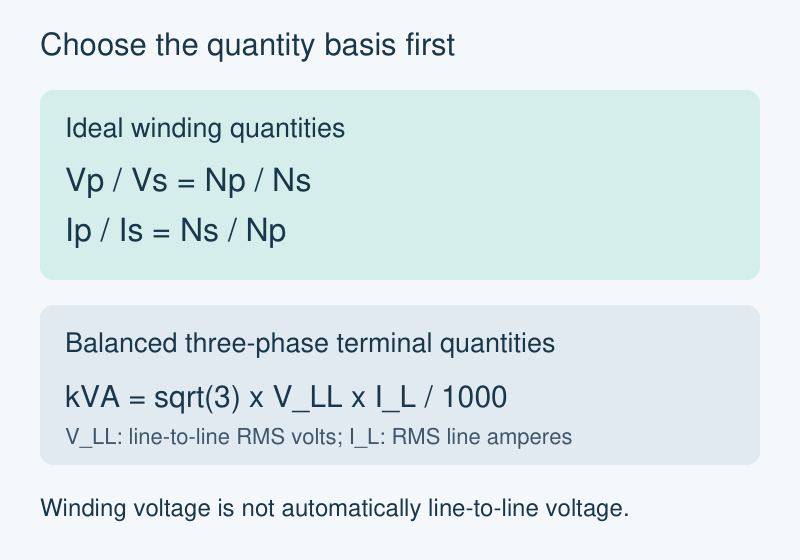
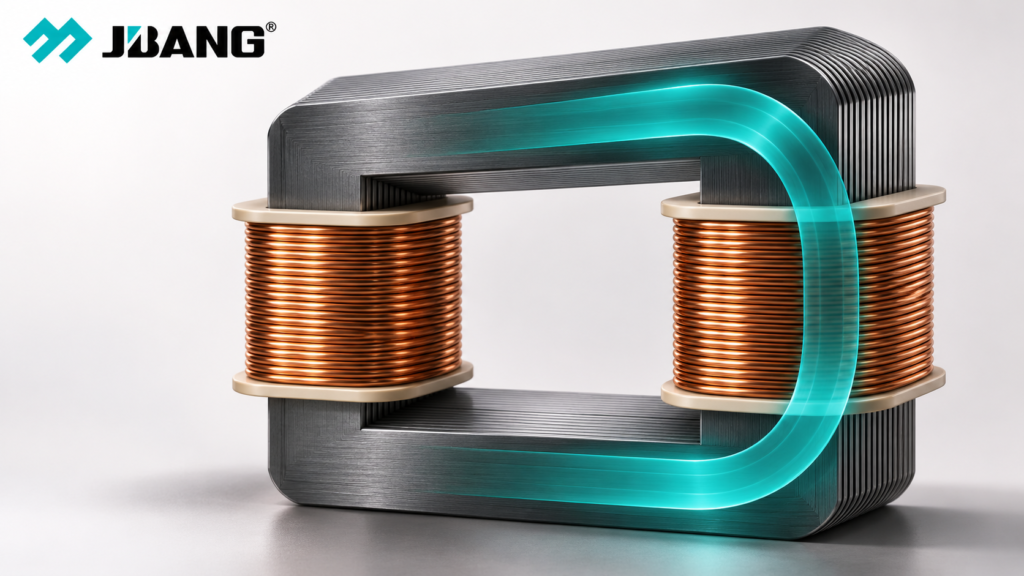
The transformer formula for an ideal winding ratio is Vp / Vs = Np / Ns. The corresponding current magnitudes vary inversely: Ip / Is = Ns / Np. For capacity calculations, use a different relationship: single-phase kVA = VI / 1000, or balanced three-phase kVA = √3 × VLL × IL / 1000.
The distinction is the quantity basis. A winding voltage, a line-to-line voltage and a total three-phase power value do not describe the same thing. Label them before substituting numbers.
Choose the transformer formula for the question
Here, p and s identify primary and secondary windings; N means turns, V means RMS voltage, I means RMS current and S means apparent power. Ratios below concern magnitudes. The ideal model neglects losses and excitation current; it is an explanatory model, not a guarantee of an actual transformer’s loaded performance.
Question
Relationship
Condition to retain
How does winding voltage change?
Vs = Vp × Ns / Np
Ideal winding quantities sharing the same linked flux
RMS voltage across, and current through, that single-phase circuit
What is balanced three-phase total apparent power?
S(kVA) = √3 × VLL × IL / 1000
Line-to-line RMS volts and RMS line amperes
What line current corresponds to three-phase kVA?
IL = 1000 × S(kVA) / (√3 × VLL)
Same balanced three-phase basis
The conversion by 1000 is essential when expressing VA in kVA. Writing volts × amperes and labelling the result kVA creates a thousandfold error. If voltage is already expressed in kilovolts, the unit conversion changes accordingly; do not apply both conversions.
Two calculation bases. The ideal winding relationships are not automatically three-phase line-voltage relationships; the terminal kVA equation explicitly uses balanced line quantities.
Worked example: ideal voltage and current ratios
Assume a hypothetical ideal single-phase transformer with 1000 primary turns and 200 secondary turns. Let the primary voltage be 1000 V RMS and the primary load current be 10 A RMS. These are chosen arithmetic inputs, not a JUBANG model or a proposed winding design.
The primary-to-secondary turns ratio is 1000 / 200 = 5. Therefore, Vs = 1000 × 200 / 1000 = 200 V. The voltage steps down by a factor of five.
The current relationship works in the opposite direction: Is = 10 × 1000 / 200 = 50 A. Reducing the voltage in this ideal example does not also reduce the current by five. Doing both would fail the apparent-power cross-check.
On the primary side, S = 1000 × 10 / 1000 = 10 kVA. On the secondary side, S = 200 × 50 / 1000 = 10 kVA. Matching products are consistent with the ideal assumptions. They do not establish a real unit’s efficiency, temperature rise, regulation or allowable loading.
Worked example: balanced three-phase kVA
Now consider a separate hypothetical balanced three-phase circuit with 400 V line-to-line and 100 A line current. This is a terminal-power calculation, not a continuation of the single-phase winding example.
S = √3 × 400 × 100 / 1000 = 69.282… kVA, or approximately 69.3 kVA. As a check, rearranging the equation gives IL = 1000 × 69.282… / (√3 × 400) = 100 A.
The result describes apparent power at the assumed operating point. It is not a transformer-size recommendation. Load characteristics, operating conditions and any required capacity allowance belong to the sizing task. A mathematically correct conversion cannot establish those missing inputs.
Three mistakes that change the meaning of the answer
Mixing winding voltage with line voltage. The turns ratio applies to winding quantities. For a three-phase transformer, the winding connections determine the relationship between winding and line quantities. Do not substitute two nameplate line voltages into a turns-count calculation without accounting for that connection basis.
Calling kVA kW. These calculations give apparent power. A real-power question also needs the relevant load power factor and operating conditions. Changing the unit label does not perform that calculation.
Treating an ideal ratio as loaded performance. The ideal example deliberately excludes real losses and excitation. It cannot predict an actual secondary terminal voltage under every load condition, nor can its current calculation select cables or protective devices.
Use actual equipment data for the next calculation
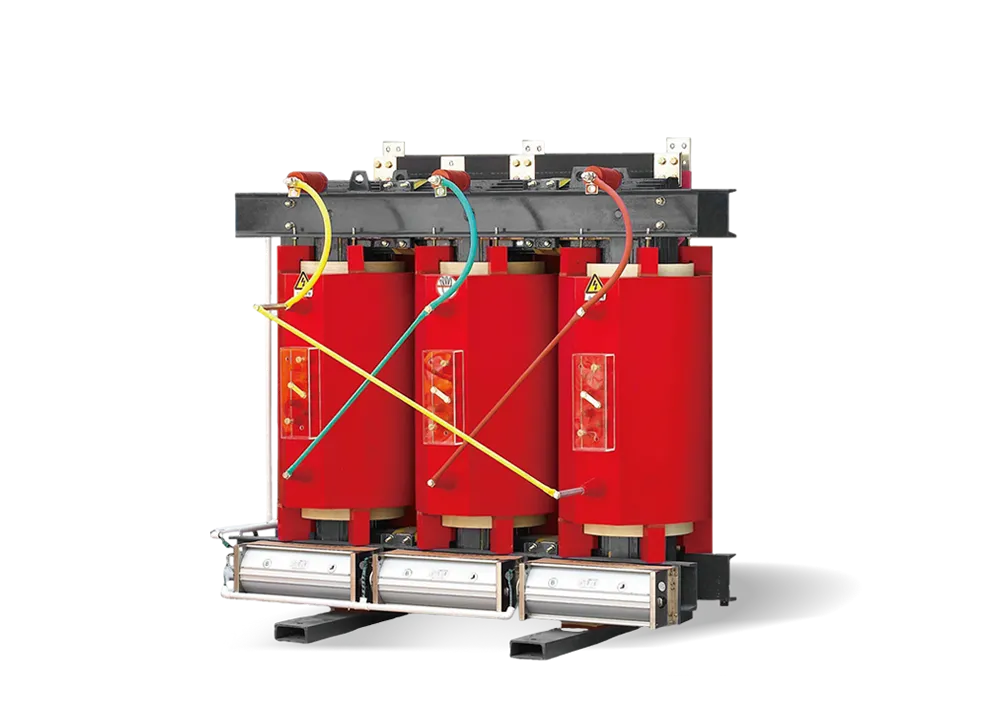
The published JUBANG resin-insulated dry-type transformer family provides a product route when the question moves from equations to an equipment enquiry. Use the actual offered voltage, phase, connection and rating data rather than the hypothetical inputs above.
A useful calculation note records the known quantities, their units, the equation, its assumptions and the result. Keeping those five items together lets another reader reproduce the arithmetic and identify whether the remaining question is ratio, apparent power or equipment sizing.
Products are exported to more than 100 countries and regions such as Africa, the Middle East, and the United Kingdom and Europe. It is a leading manufacturer of power distribution equipment in China.

 JUBANG