From transformers and switchgear to ring main units, substations, circuit breakers and smart components, Jubang provides integrated product support for power distribution projects.
Discover Jubang’s strengths in technology R&D, quality testing and smart manufacturing, supporting reliable electrical equipment and efficient power distribution solutions for global customers.
From technical consultation and OEM/ODM customization to EPC support, smart O&M, delivery documentation and after-sales service, Jubang supports your project at every stage.
Explore Jubang Group’s development history, intelligent manufacturing base, R&D platforms, CNAS-accredited laboratory and global project service capabilities.
Switchgear vs Switchboard: Construction, Protection and Selection
Release Time: 2026-11-09
In a switchgear vs switchboard comparison, both assemblies can distribute power and contain switching, protection and metering equipment. For a North American low-voltage project, the distinction starts with the assembly reference and declared duties, then the actual construction. Cabinet appearance or the presence of a removable breaker is not enough.
This article concerns LV distribution assemblies. “Switchgear” also has wider uses, including medium-voltage equipment, so an international enquiry should first state the voltage class and the terminology used in its specification.
Cover image: conceptual LV cabinet study, not a photograph of a JUBANG installation or a classification drawing.
Switchgear vs switchboard: start with assembly identity
UL 1558 addresses metal-enclosed low-voltage power circuit breaker switchgear. UL 891 addresses dead-front switchboards. These references describe assemblies, not just the protective devices installed inside them. A breaker type or accessory should not be used as a substitute for identifying the complete equipment.
For the buyer, the immediate question is which exact assembly the supplier proposes and which reference applies to it. A broad brochure heading does not resolve the offered configuration. This is especially relevant when a translated product name is being compared with a North American specification.
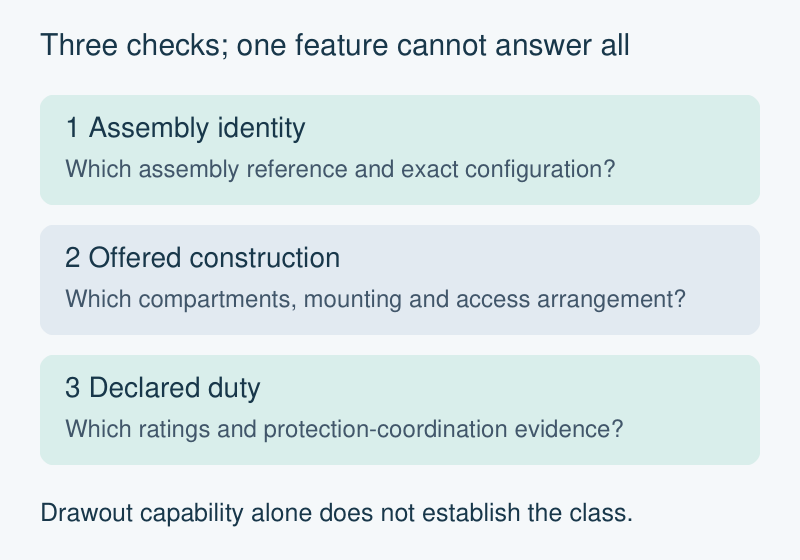
Separate the three questions. An answer about a mounting feature does not establish the assembly reference or its fault-duty evidence.
Compare construction and duties in separate rows
The practical differences concern how devices are arranged, how the assembly is accessed and what duties it is declared to support. Typical arrangements are useful starting points, but they are not universal rules for every product sold under either name.
Review point
What a useful offer identifies
Common shortcut to avoid
Assembly classification
The applicable assembly reference and offered equipment identification
Classifying the whole lineup from its main breaker alone
Device arrangement
Individual or group mounting, compartment layout and connections
Assuming every switchboard uses fixed devices
Access and service arrangement
Required front/rear access and configuration-specific instructions
Assuming all switchgear requires rear access or every switchboard is front-only
Fault duty
Applicable assembly rating and its conditions
Substituting a breaker interrupting value for the complete assembly duty
Protection coordination
Device functions, settings where relevant and supporting study/documentation
Assuming the equipment name guarantees selective operation
Keep breaking and withstand questions separate. An interrupting duty concerns opening a circuit under specified conditions; a withstand duty concerns carrying the specified event. The UL 891 public scope excludes switchboards with short-time current ratings. That is a meaningful scope distinction, but it does not justify assigning one universal fault duration to every offer.
The design team should identify the duties required for the project’s source arrangements and protection strategy. The supplier can then respond against those duties. Without that shared basis, comparing the largest fault-current figures in two brochures can conceal different kinds of rating.
Why a drawout breaker does not settle the answer
Drawout capability is a construction feature, not an exclusive label for switchgear. Published switchboard designs include drawout molded-case breakers. Therefore, seeing a removable device does not prove that the assembly is switchgear under the project’s specified reference.
The same caution applies to access. Switchboards can have front-only or front/rear access arrangements, depending on the design. The offered general arrangement should show which access zones the project must provide. A frontal cabinet image cannot answer a room-layout question.
Nor does a removable device, by itself, establish permission to perform work with adjacent equipment energized. The installation conditions and equipment-specific procedures remain separate from the classification discussion. Do not turn a serviceability feature into a blanket operating instruction.
Protection exists in both equipment families
A switchboard can contain protective circuit breakers or fuses. Describing it as distribution equipment without protection is incorrect. The relevant comparison is which functions, device combinations and assembly duties are offered, and whether they meet the project’s requirements.
Consider a specification that asks for a removable feeder and a defined protection-coordination outcome. An offer saying “drawout switchboard” addresses part of the mounting question. It does not yet answer the assembly-duty or coordination questions. Those need their own documents, even if the proposed mounting arrangement is acceptable.
This is a useful way to review alternatives: identify the requirement, state which offered feature answers it, and list the remaining evidence. It prevents one attractive feature from being treated as proof that all requirements are satisfied.
Translate the comparison into an equipment discussion
JUBANG’s published BlokSeT low-voltage switchgear scope includes power distribution and motor control. It provides a starting point for discussing an LV configuration. The product name does not establish a UL 1558 or UL 891 listing for a particular offer.
Provide the intended assembly reference, electrical duties and access constraints with the enquiry. Ask the supplier to identify the offered configuration and any deviations against those inputs. This produces a comparison that an engineer or buyer can check, rather than a decision based on which cabinet looks more substantial.
Products are exported to more than 100 countries and regions such as Africa, the Middle East, and the United Kingdom and Europe. It is a leading manufacturer of power distribution equipment in China.

 JUBANG