From transformers and switchgear to ring main units, substations, circuit breakers and smart components, Jubang provides integrated product support for power distribution projects.
Discover Jubang’s strengths in technology R&D, quality testing and smart manufacturing, supporting reliable electrical equipment and efficient power distribution solutions for global customers.
From technical consultation and OEM/ODM customization to EPC support, smart O&M, delivery documentation and after-sales service, Jubang supports your project at every stage.
Explore Jubang Group’s development history, intelligent manufacturing base, R&D platforms, CNAS-accredited laboratory and global project service capabilities.
Metal-Enclosed vs Metal-Clad Switchgear: Compartments and Protection
Release Time: 2026-11-08
The first point in a metal enclosed vs metal clad switchgear comparison is that these are not always opposing categories. In IEEE terminology, metal-clad is a defined form of metal-enclosed power switchgear. The useful purchasing question is which specific assembly category, construction and protection arrangement the offer describes.
Many comparisons use “metal-enclosed” as shorthand for metal-enclosed interrupter switchgear, or MEI. That narrower comparison can be useful, but the shorthand should be stated. Otherwise, a buyer may mistake the broad enclosure family for a single design with one switching device or compartment arrangement.
Cover image: conceptual compartment illustration, not a JUBANG product drawing or evidence of a tested installation.
Metal enclosed vs metal clad switchgear: define the terms
IEEE C37.20.2 addresses metal-clad MV switchgear with drawout electrically operated circuit breakers and grounded metal separation of major functions. Its public scope identifies instrumentation, main bus and incoming/outgoing connections as compartmentalized components. The associated construction concept is more specific than simply putting equipment in a metal cabinet.
Metal-enclosed interrupter switchgear has its own category, addressed by IEEE C37.20.3. Its public scope includes arrangements containing interrupter switches, selector switches, power fuses, circuit breakers and associated control/protection equipment. It should not be reduced to the assertion that all such equipment contains fuses and cannot contain breakers.
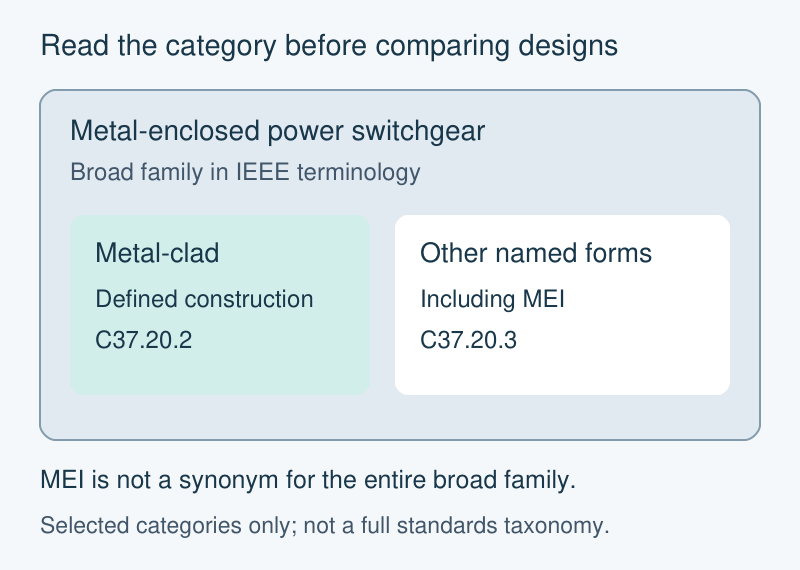
Selected IEEE terminology relationships, not a complete standards map. MEI names a specific category; it does not represent every design in the broad metal-enclosed family.
For an international enquiry, agree the terminology before comparing bids. A supplier’s translated product name does not establish a one-to-one mapping between IEEE terminology and another standards system. The specification should identify its governing reference, edition and required evidence.
What compartmentalization changes in the comparison
For metal-clad equipment, the important construction questions concern the separation of major primary components, the removable interrupting device and the separation of control/instrument functions from primary circuits. A single external photograph cannot show all of those relationships.
The following review separates what a category tells you from what still needs an offered drawing or document. It avoids treating every alternative design as an empty, unpartitioned cabinet.
Comparison layer
Question to resolve
Useful evidence
Assembly identity
Does “metal-enclosed” mean the broad family or a specific MEI design?
Named assembly category and contractual reference
Primary compartments
Which major functions are separated by grounded metal barriers?
Section views and partition descriptions for the offered arrangement
Main switching device
What interrupts load or fault current, and is the device fixed or removable?
Device schedule and mounting description
Control and protection
Which devices detect conditions, initiate interruption and provide indications?
Protection/control description and schematic references
Declared performance
Which tests and duties apply to this assembly configuration?
Rating schedule and applicable test documentation
The distinction between drawings and test evidence is deliberate. A section view can explain a barrier or cable route. It cannot, on its own, establish a breaking duty or the result of a performance test. Conversely, a generic family test reference may leave the buyer uncertain about the arrangement being offered.
Construction does not select the protection scheme
The enclosure category and the protection arrangement should be reviewed separately. Knowing that a breaker is removable does not identify its relay functions or settings. Knowing that an offer uses a fuse does not establish the correct characteristic for the connected circuit.
The project needs the actual switching/protection device references and their relationship to the equipment duties. Ask what is included in the assembly and what comes from an external protection or control system. This is more precise than assuming the more compartmentalized option automatically includes every desired protective function.
Internal-arc performance is also a separate evidence question. Do not infer arc-resistant qualification, an acceptable access condition or a complete safety outcome from the words “metal-clad,” from a grounded partition, or from a cutaway image. If the project requires a particular internal-arc performance, name that requirement and request the corresponding configuration-specific evidence.
Apply the distinction to a published construction description
The JUBANG KYN61-40.5 product description identifies relay/instrument, handcart, cable and busbar compartments separated by earthed metal partitions. That is useful evidence for discussing the published construction. It does not by itself verify IEEE conformity or establish the exact layout of a project offer.
A focused technical question would point to one relationship: for example, how the offered cable compartment is separated from the bus compartment, and where that separation appears on the section drawing. A different question would ask which protection devices are included. Keeping those questions distinct makes the supplier’s answers easier to verify.
For bid review, mark each response as a category statement, an offered-construction statement or a performance statement. If two suppliers use different category names, compare their drawings and declared duties against the same project requirement before treating the offers as equivalent. The comparison then rests on the equipment being supplied, rather than on a translated label.
Products are exported to more than 100 countries and regions such as Africa, the Middle East, and the United Kingdom and Europe. It is a leading manufacturer of power distribution equipment in China.

 JUBANG