JUBANG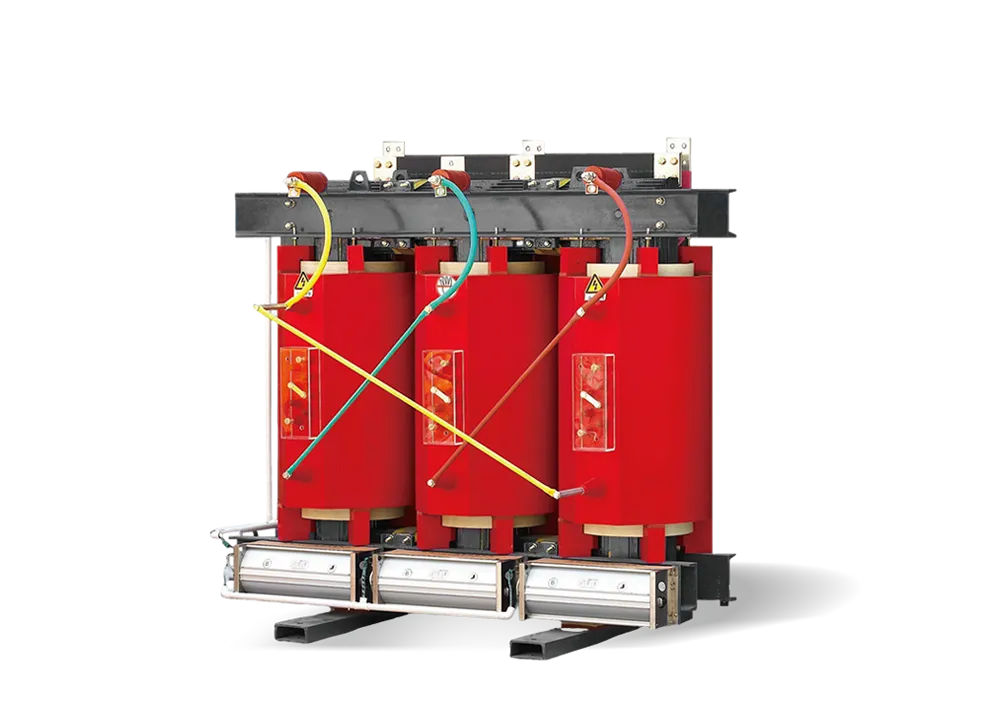
When a hospital-project electrical lead in Dubai approved an indoor substation package, the selection action was to accept a resin-transformer quotation with only a kVA figure. In the first hot commissioning week, a winding-temperature alarm appeared and the consultant withheld approval. The equipment was not defective: the specification had omitted enclosure ventilation, harmonic duty, insulation class and service access. Reissuing it around those conditions restored a reviewable design.
Summary: A Flame-retardant resin dry type transformer can suit indoor distribution where avoiding liquid dielectric matters, but “pollution-free” and “maintenance-free” are qualified lifecycle descriptions, not absolutes. IEC 60076-11 addresses dry-type transformers; specify the environment, temperature rise, insulation level and inspection plan before comparing lifetime loss, ventilation and outage exposure with purchase cost.
Cast-resin units encapsulate windings in resin rather than mineral oil. They can reduce liquid-leak consequences in sensitive locations, but do not erase manufacturing impacts, end-of-life obligations or the need to control dust, heat and electrical connections.
How cast resin changes the insulation and fire-risk conversation
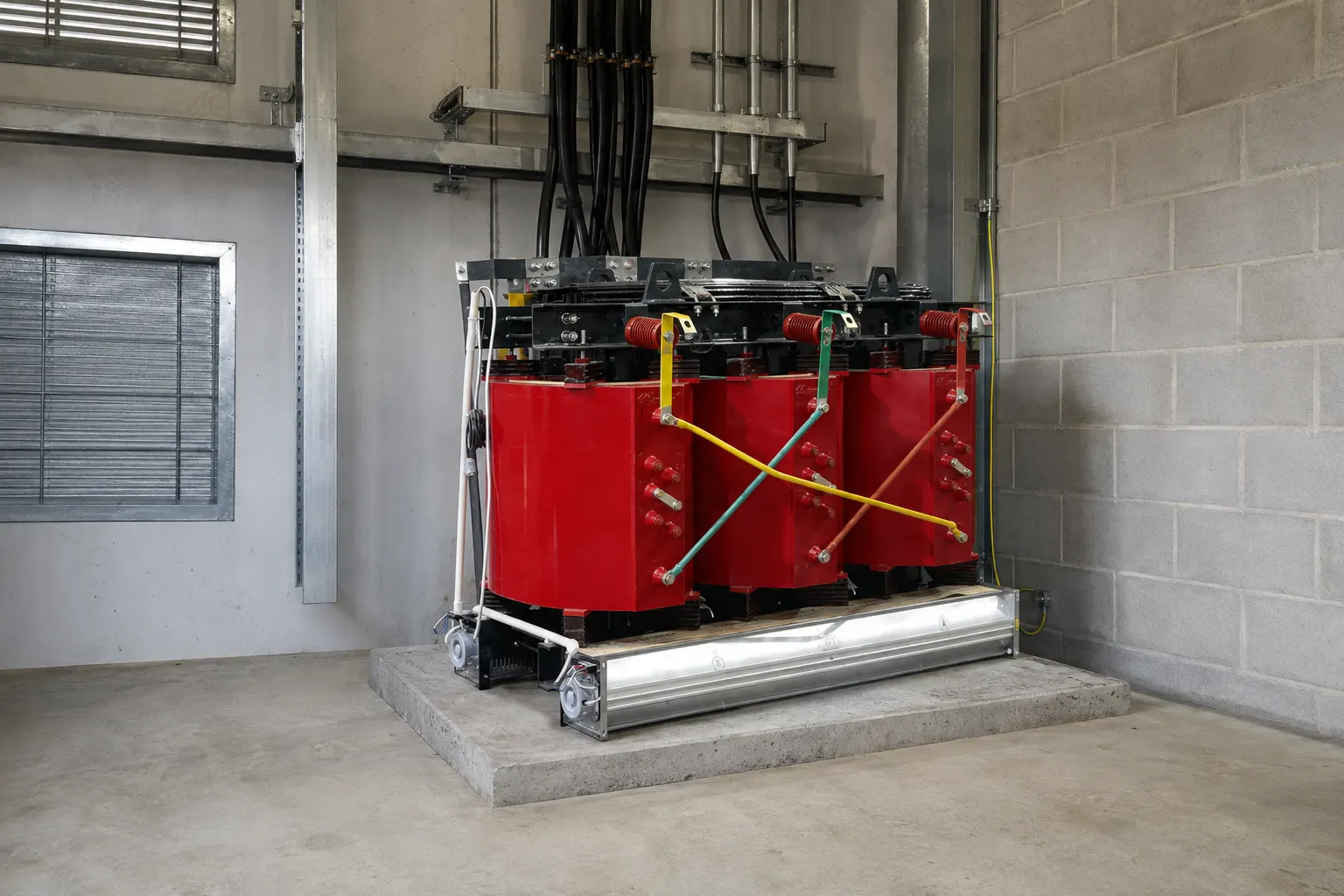
In a cast resin insulation system, the high-voltage winding is cast or encapsulated in resin for dielectric separation and mechanical restraint. IEC 60076-11 provides dry-type climate, environmental and fire-behaviour classifications that must be selected, not assumed. Ask for the declared class and relevant test evidence; a resin surface is not a universal fire certificate.
An SCB series dry type transformer no pollution no maintenance is often shorthand for “no insulating oil to sample, contain or replace.” It can remove liquid-management tasks and spill exposure, not environmental footprint: resin, copper and steel still need responsible lifecycle handling. The TCO value is avoided liquid-management infrastructure where the building risk assessment would otherwise require it—not an automatic saving everywhere.
IEC 60076-3 separates insulation-level requirements from a broad “fire-safe” label. At 6 kV, 10 kV or 35 kV, system voltage, lightning-impulse and power-frequency withstand requirements must align with network and switchgear coordination. Voltage class alone can produce a quotation that fails approval review.
Temperature rise, loading and ventilation must be specified together
Common insulation thermal classes include 155 °C and 180 °C; permissible winding temperature rise, ambient reference and test method must be stated for the duty. IEC 60076-11 governs dry-type thermal performance, while loading determines whether rating is continuous, cyclic or a short peak. A temperature-rise specification should identify ambient conditions, altitude, enclosure, ventilation and harmonics.
Heat trapped in a poorly ventilated room raises winding temperature and accelerates ageing. Cooling fans may extend loading, but add auxiliaries and inspection points. For TCO, compare an illustrative annual loss-energy calculation—no-load loss plus load loss at expected load factor, operating hours and local energy cost—with ventilation, fan and downtime cost. Do not compare only one 1,000 kVA nameplate with another.
IEC 60076-1 supplies general requirements and rating conventions. Ask how temperature-rise testing represents the proposed enclosure and forced-air arrangement; this prevents an open-type test assumption being transferred to a hot electrical room.
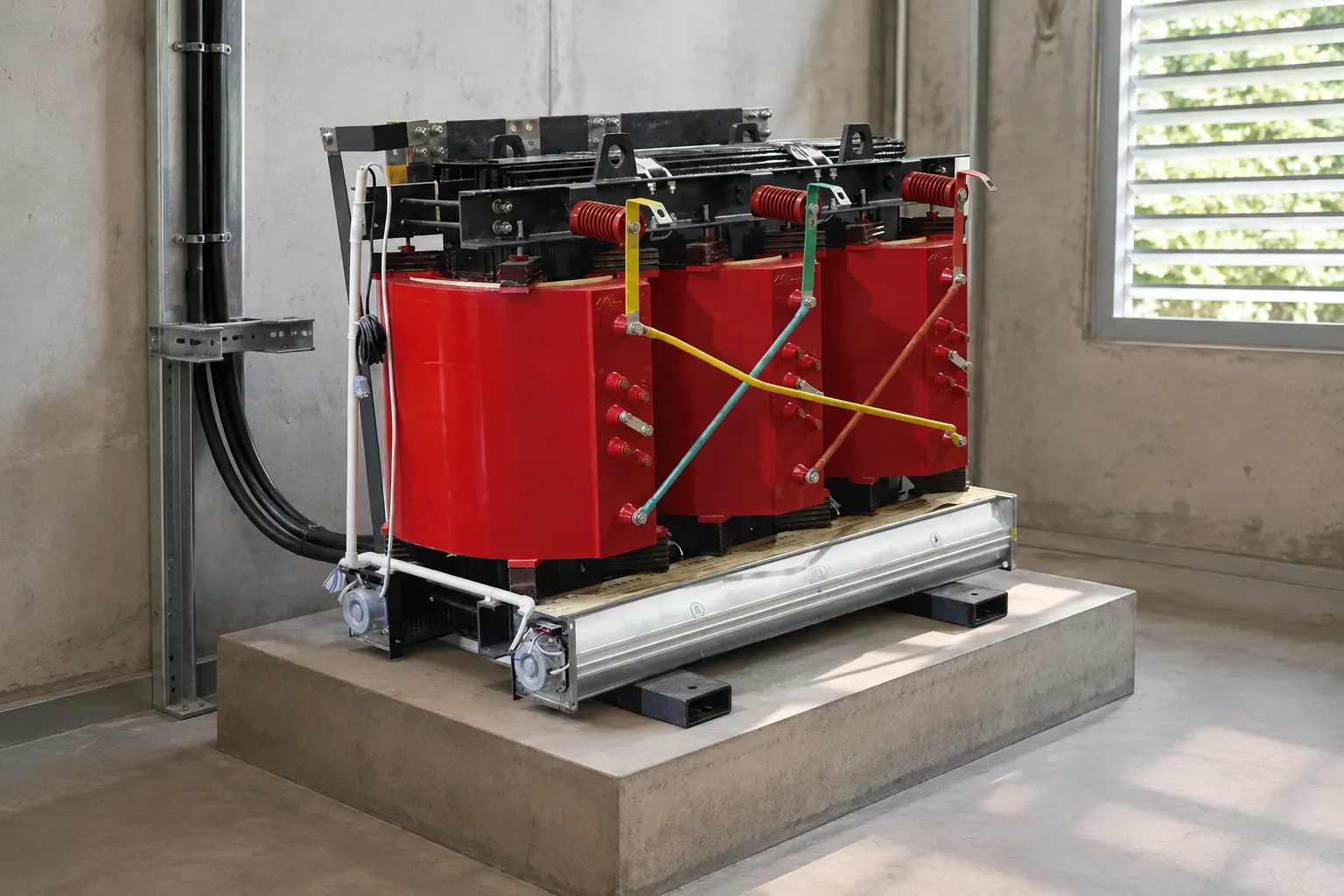
Indoor installation is a system design, not a location label
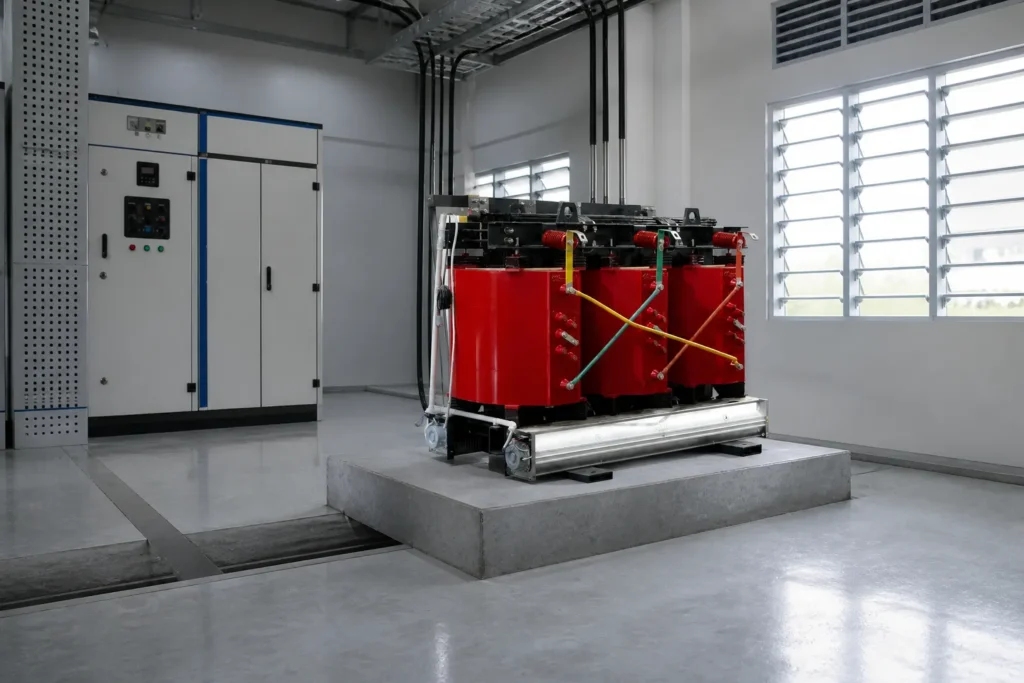
Dry type transformers are widely used indoors because they avoid a liquid-filled tank, but an installation still needs clearances, access, fire strategy, ventilation and an earthed enclosure where required. IEC 60076-11 classes translate humidity, condensation, dust and corrosion into a specification. For a 10 kV installation, coordinate transformer insulation with upstream protection and downstream distribution under IEC 60076-3.
Late room changes cost more than a marginal equipment option. Maintenance access and a direct cooling-air route can reduce shutdown time; a compact room needing repeated cleaning or temporary cooling transfers cost into operations. An SCB series dry type transformer no pollution no maintenance must be evaluated against site conditions, not treated as environment-indifferent.
Maintenance-free means no oil service—not no service plan
A sensible program includes visual inspection for dust, moisture, abnormal noise, vibration and damaged surfaces, plus condition-appropriate checks of terminations, earthing, cooling equipment and protective devices. Thermography can identify hot connections under load. Set the interval by duty and environment, not an oil-filled transformer sheet.
IEC 60076-5 covers short-circuit withstand, so fault duty and protection coordination belong in selection. A resin transformer may avoid oil sampling, yet loose terminals, blocked airflow and fault stresses remain risks. The TCO benefit is fewer fluid-related tasks, balanced against inspection labour and missed-defect exposure. This is the useful procurement meaning of an SCB series dry type transformer no pollution no maintenance.
Cast resin and VPI: compare the operating fit, not a slogan
| Decision dimension | Cast-resin dry type | VPI dry type | TCO question |
|---|---|---|---|
| Winding insulation | High-voltage winding is resin cast or encapsulated. | Windings are vacuum-pressure impregnated with varnish. | Which construction fits contamination and duty? |
| Indoor fire and liquid management | No mineral-oil dielectric in the active part. | Also avoids an oil-filled tank. | What building controls or spill provisions are avoided or still required? |
| Cooling and cleanliness | Needs unobstructed airflow and clean surfaces. | Needs airflow; accessibility varies by design. | What cleaning and access cost does the room create? |
| Fault-duty review | Specify short-circuit withstand to IEC 60076-5. | Specify the same network fault duty. | What is the cost of a mismatch with protection coordination? |
The honest comparison is not “resin always better.” Cast resin may suit indoor liquid-risk reduction, while VPI may fit another construction and project requirement. Both need declared ratings, test documentation and a maintainable room. Compare a Flame-retardant resin dry type transformer at the same voltage, insulation level, temperature rise and accessory scope.
Application matrix: put the duty conditions on the requisition
| Application | Specification focus | Numeric or standard checkpoint | Lifecycle implication |
|---|---|---|---|
| Hospital or commercial tower | Indoor access, acoustic limits, continuity plan | State ambient and required temperature rise under IEC 60076-11 | Design for safe service windows and minimal disruption. |
| Metro, airport or public facility | Fire strategy, smoke pathways, network fault duty | Confirm declared fire/environmental class; review IEC 60076-5 fault withstand | Avoid late approval changes to rooms or protection settings. |
| Industrial plant | Harmonics, dust, cyclic loading and ventilation | Specify voltage/insulation coordination per IEC 60076-3 | Size cooling and inspection resources for real production duty. |
| 35 kV distribution project | Insulation levels, switching arrangement and access | State system voltage and lightning-impulse requirement | Prevent costly rework at interface testing. |
A Flame-retardant resin dry type transformer can support these applications when its declared construction and test evidence match the duty. “Flame-retardant” never replaces project fire engineering or local building, utility and civil-defence requirements.
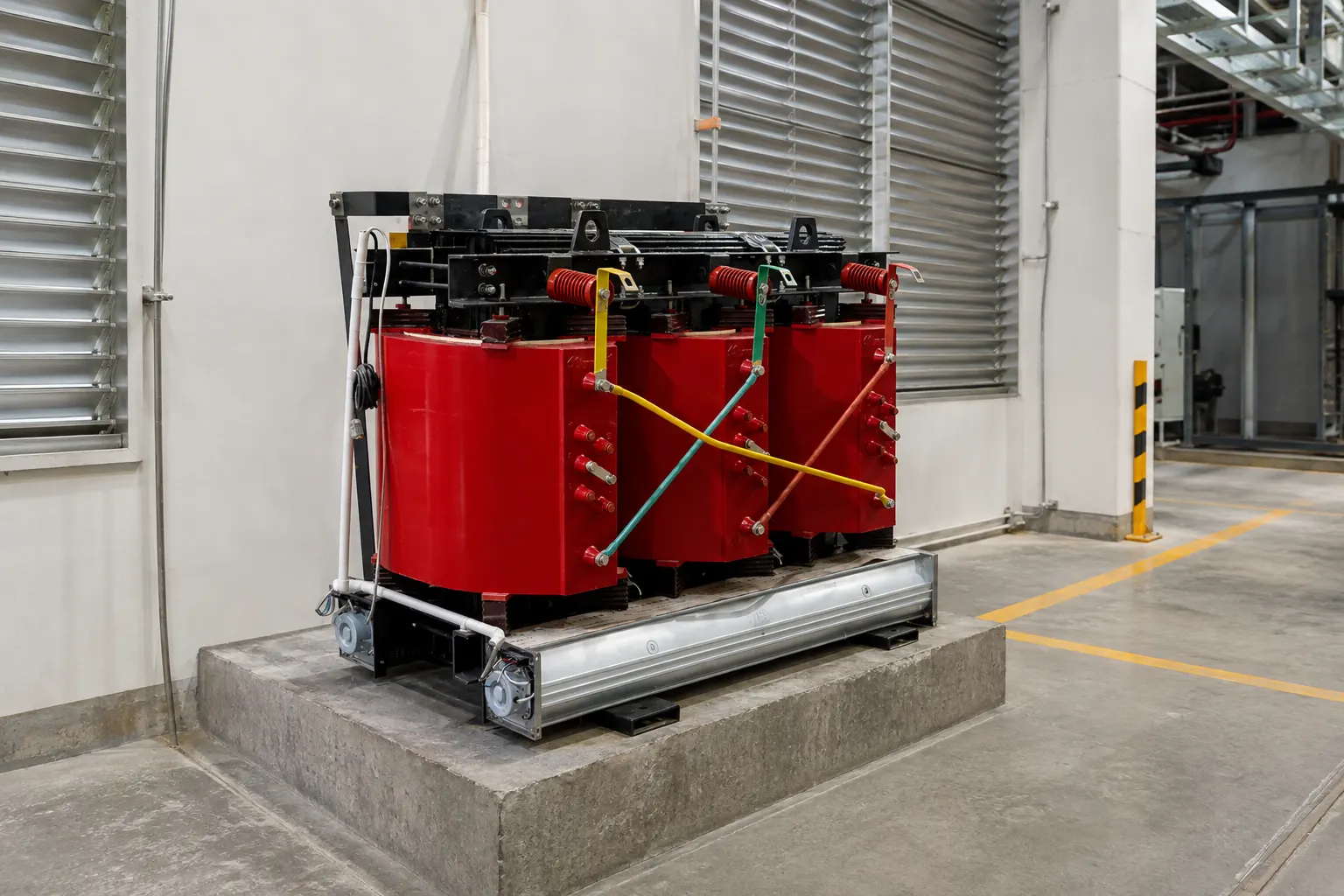
Standards, market access and defensible documentation
Use IEC 60076-1 for general requirements, IEC 60076-3 for insulation levels and dielectric tests, IEC 60076-5 for short-circuit withstand, and IEC 60076-11 for dry-type requirements. These are standards, not a global product certificate or automatic market permission. Destination laws, utility specifications and building rules determine the required declarations, reports or certifications.
Unsupported “zero pollution,” “fireproof” or “maintenance-free” claims create approval, warranty and liability exposure. Ask for the offered configuration, test basis and documentation scope; then have the EPC, owner and authority assess local applicability. The payoff is lifecycle risk allocation: price the correct scope before energisation.
Five procurement actions before releasing the order
- Translate the rating into voltage, vector group, tapping, impedance, losses, ambient, altitude, enclosure and duty cycle.
- Set IEC 60076-11 environmental, climate and fire-behaviour classes after reviewing the room and fire strategy.
- State IEC 60076-3 insulation levels and IEC 60076-5 short-circuit duty with the protection engineer.
- Compare illustrative lifetime loss-energy cost with ventilation, fan, access and planned-inspection cost.
- Define drawings, routine-test records, declared classes, terminal data and installation instructions as submittals.
For buyers sourcing in China, an SCB series dry type transformer no pollution no maintenance option can be reviewed against that requirement sheet; Jubang Group can discuss configuration and documentation without replacing engineering approval. For higher voltage scopes, compare the 35 kV resin-insulated dry type transformer range against insulation and access constraints.
Frequently asked questions
What is a Flame-Retardant Resin Dry Type Transformers?
It is a dry-type transformer with resin insulation construction for the specified duty and fire-behaviour classification. Selection still depends on the individual unit’s IEC 60076-11 declaration, rating and test documentation.
Why would you use a dry type transformer?
Use one when an indoor project benefits from avoiding a mineral-oil dielectric or when building layout favours dry construction. Confirm ventilation, contamination, fault duty and maintenance access first.
Which is better, an oil type or dry type transformer?
Neither is universally better. Oil-filled transformers can be well suited to many outdoor and utility applications, while dry type units can fit indoor, public-facing or liquid-sensitive locations; the right choice follows duty, site controls, loss evaluation and local requirements.
What is the difference between cast resin and VPI dry type transformers?
Cast-resin designs use resin casting or encapsulation around relevant windings, whereas VPI designs use vacuum-pressure varnish impregnation. Compare declared IEC requirements, mechanical environment, cooling arrangement, accessibility and expected service practice—not only insulation names.
Are dry type transformers suitable for indoor installation?
They are commonly used indoors, provided that the room, enclosure, clearances, ventilation and fire strategy support the selected unit. Humidity, dust and ambient temperature should be reflected in the IEC 60076-11 classes and the installation instructions.
How do you select a dry type transformer rating?
Start with load profile, kVA demand, voltage, impedance, vector group, fault duty, harmonics, ambient and altitude. Then verify insulation, temperature rise, cooling and losses; a dry type distribution transformer with on-load tap changing may suit voltage-regulation duty.
References
- IEC 60076-1: Power transformers—Part 1: General
- IEC 60076-3: Power transformers—Part 3: Insulation levels, dielectric tests and external clearances in air
- IEC 60076-5: Power transformers—Part 5: Ability to withstand short circuit
- IEC 60076-11: Power transformers—Part 11: Dry-type transformers
A dry transformer specification earns its value before delivery: it makes the room, network and service assumptions visible while changes are still inexpensive.
When your team is comparing compliant configurations for a 6–10 kV indoor project, review the SCB resin-insulated dry type transformer and contact Jubang Group with the duty sheet, insulation requirements and site conditions.