From transformers and switchgear to ring main units, substations, circuit breakers and smart components, Jubang provides integrated product support for power distribution projects.
Discover Jubang’s strengths in technology R&D, quality testing and smart manufacturing, supporting reliable electrical equipment and efficient power distribution solutions for global customers.
From technical consultation and OEM/ODM customization to EPC support, smart O&M, delivery documentation and after-sales service, Jubang supports your project at every stage.
Explore Jubang Group’s development history, intelligent manufacturing base, R&D platforms, CNAS-accredited laboratory and global project service capabilities.
Outdoor Vacuum Circuit Breaker: Applications, Key Specs, and Selection Guide
Release Time: 2026-07-02
An outdoor vacuum circuit breaker (VCB) is a medium-voltage switch installed on overhead distribution lines or outdoor substation structures. It uses a vacuum interrupter to open and close load current and to clear short-circuit faults—so utilities, EPC contractors, and industrial owners can protect feeders, sectionalize grids, and integrate automation without bringing the breaker indoors.
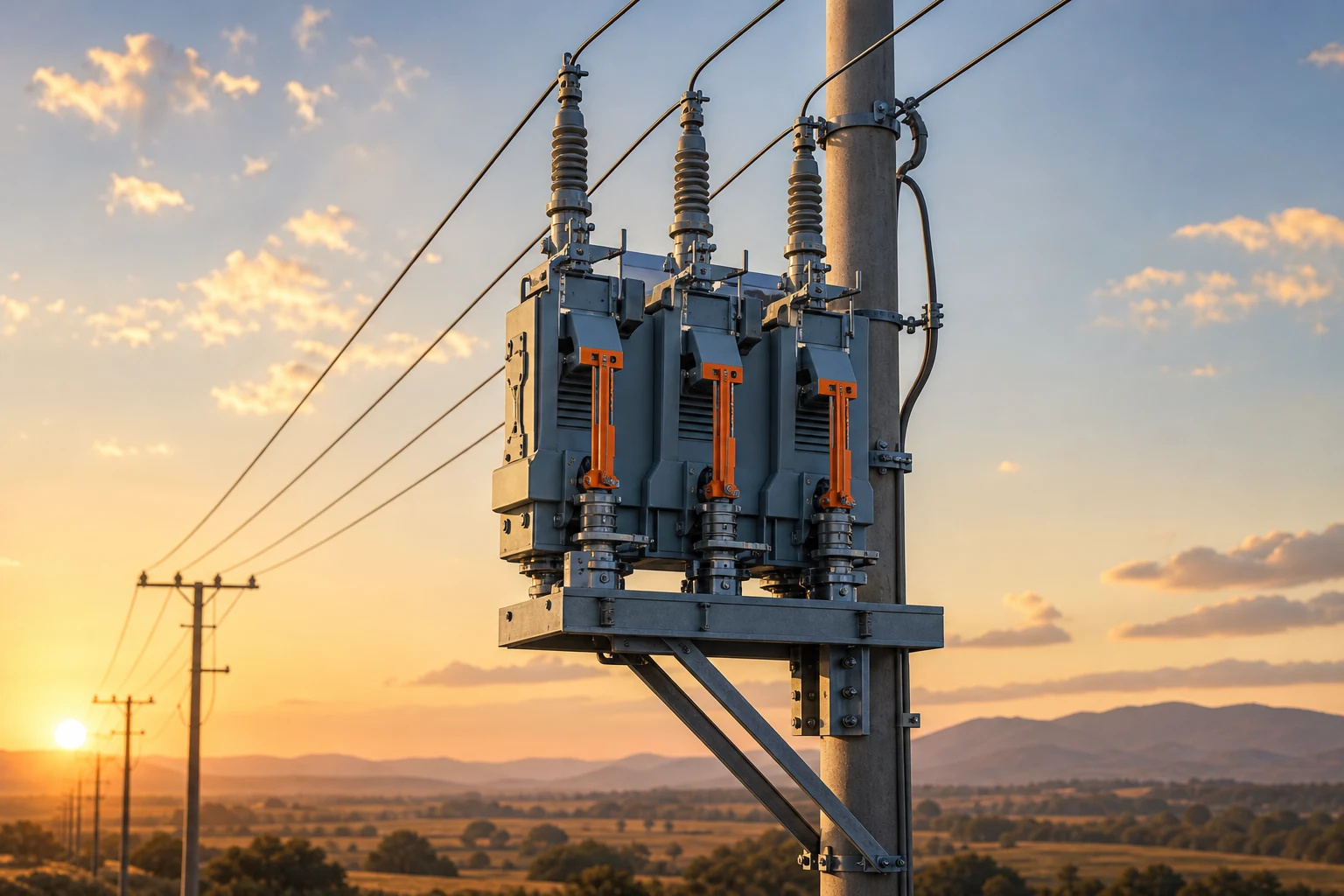
Concept illustration: pole-mounted outdoor VCB in an overhead distribution setting (not a product photo).
Part 1. What is an outdoor vacuum circuit breaker?
An outdoor vacuum circuit breaker is an automatic switching device rated for exposed installation on poles, steel structures, or outdoor bays. Inside each pole, a vacuum interrupter extinguishes the arc when contacts separate; the surrounding enclosure, insulators, and operating mechanism are designed for rain, UV, pollution, and temperature swings that would be unacceptable for a typical indoor panel breaker.
On most distribution networks, outdoor VCBs perform three jobs:
Feeder protection — interrupt fault current on overhead lines.
Sectionalizing and tie switching — divide long rural or suburban feeders to limit outage scope.
Automation-ready switching — when paired with an FTU or recloser controller, support remote operation and fault isolation.
Common naming follows regional standards. The widely referenced ZW32 family, for example, denotes an outdoor (W) vacuum (Z) breaker platform used on 12 kV, 24 kV, and 40.5 kV overhead systems.
Part 2. How is an outdoor VCB different from an indoor vacuum circuit breaker?
Both indoor and outdoor units rely on vacuum interrupters, but the installation environment drives different engineering priorities.
Factor
Outdoor pole-mounted VCB
Indoor metal-clad VCB
Enclosure
Weather-resistant pole or pillar structure; higher IP requirement
Switchgear cubicle; climate-controlled room
Insulation
Embedded poles, silicone or epoxy insulators for pollution
Tip: If your breaker sits in a climate-controlled switchgear room, specify an indoor VCB or metal-clad switchgear. If the protection point is on an overhead line or an outdoor structure, an outdoor VCB is the correct category—do not derate an indoor unit for direct sun and driving rain.
Part 3. Where are outdoor pole-mounted VCBs used?
Outdoor VCBs appear wherever medium-voltage overhead lines need switching and protection:
Urban and rural grid upgrades — feeder breakers and sectionalizers on 11 kV / 12 kV / 33 kV lines.
Industrial and mining distribution — outdoor feeders to plants, quarries, and processing sites.
Renewable collection zones — switching on MV collectors feeding substations (often alongside prefabricated substations).
Substation outgoing lines — pole-mounted bays where space or cost favors line-mounted equipment.
From the field: “We need a pole-mounted unit that can handle frequent switching on a rural feeder without constant maintenance.” — This is why mechanism life, sealed insulation, and optional automation matter as much as headline kA ratings.
Part 4. Which ratings matter most when you specify a VCB?
Start with system data from your single-line diagram and utility/interconnection requirements, then verify each rating on the datasheet.
Parameter
What it means
Why it matters
Rated voltage (kV)
Maximum system voltage class (e.g., 12, 24, 40.5 kV)
Insulation level and clearance for your network
Rated continuous current (A)
Normal load the breaker carries
Prevents thermal overload on peak load
Rated short-circuit breaking current (kA)
Maximum fault current the VCB can interrupt
Must exceed calculated fault level at the installation point
Mechanical life (operations)
Opening/closing cycles before overhaul
Drives maintenance cost on frequently switched feeders
Power-frequency & impulse withstand
Dielectric strength (dry/wet)
Critical in humid or polluted climates
Operating sequence
e.g., O-0.3s-CO-3s-CO
Must match utility protection philosophy
From the field: “Breaking capacity has to exceed our calculated fault level—undersizing is not negotiable.” — Always use the maximum prospective short-circuit current at the pole, including future grid reinforcement if applicable.
Tip: For export projects, confirm whether the buyer references IEC 62271-100, IEEE C37 series, or local utility specs. The parameter names differ, but rated voltage, current, and short-circuit breaking capacity remain the universal checkpoints.
Part 5. Spring vs permanent magnet mechanisms—and when to add an FTU
Outdoor VCBs use spring-operated or permanent-magnet operating mechanisms:
Spring mechanism — mature, cost-effective; typical mechanical life around 10,000 operations on mainstream 12 kV units. Suited to general urban/rural feeders with moderate switching frequency.
Permanent magnet mechanism — higher mechanical endurance (often 30,000+ operations in industry literature), lower holding energy; favored for smart grids and frequently switched lines.
Add an FTU (fault passage indicator / feeder terminal unit) or recloser controller when you need remote tripping/closing, SCADA integration, or automated sectionalizing. Integrated CT/VT and communication (Modbus, IEC 60870-5-104, etc.) reduce field wiring on pole structures.
Tip: If maintenance crews require a visible isolation gap, specify a side-mounted disconnector combined with the VCB rather than relying on the breaker contacts alone for lockout/tagout visibility.
Part 6. How to match environment, insulation, and installation
Outdoor performance depends on enclosure sealing, insulator material, and pollution class—not only electrical ratings.
IP rating — pole equipment often targets IP65 or equivalent for dust and driving rain.
Insulation technology — solid-sealed embedded poles and silicone rubber sheds resist tracking in coastal or industrial pollution.
Partial discharge — lower PD designs improve long-term reliability on 24 kV and 40.5 kV systems.
Mounting — confirm pole cross-arm dimensions, conductor orientation, and whether manual and motor operators share the same mounting pattern (simplifies spares).
Important: Altitude, ambient temperature above 40 °C, and seismic zones may require derating or special factory tests. Document these in your inquiry—do not assume catalog ratings cover every site without clarification.
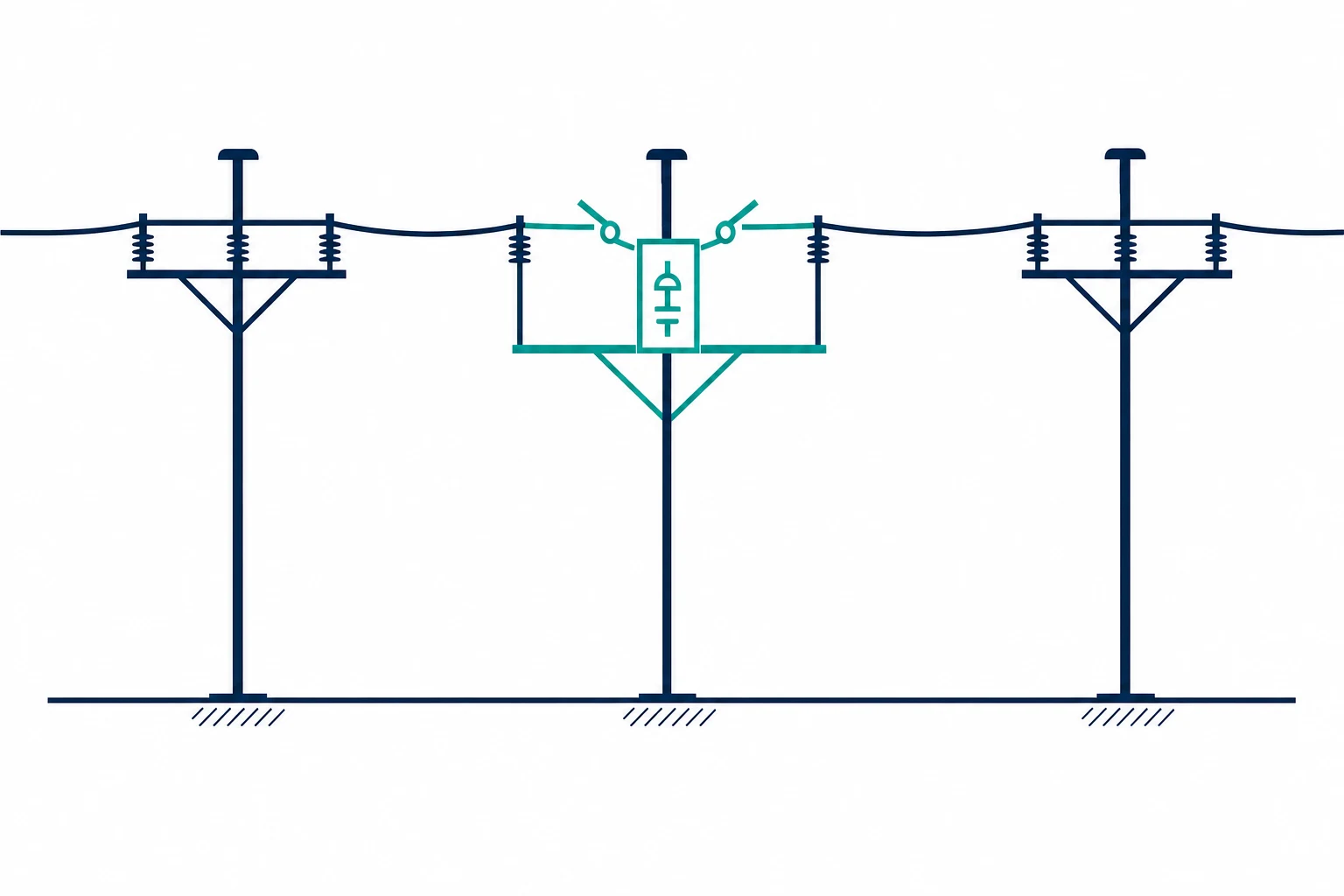
Concept illustration: sectionalizing point on an overhead MV feeder (illustration, not site-specific).
Part 7. Which outdoor VCB options fit common project profiles?
Use the table below as a starting point—not a substitute for project-specific studies.
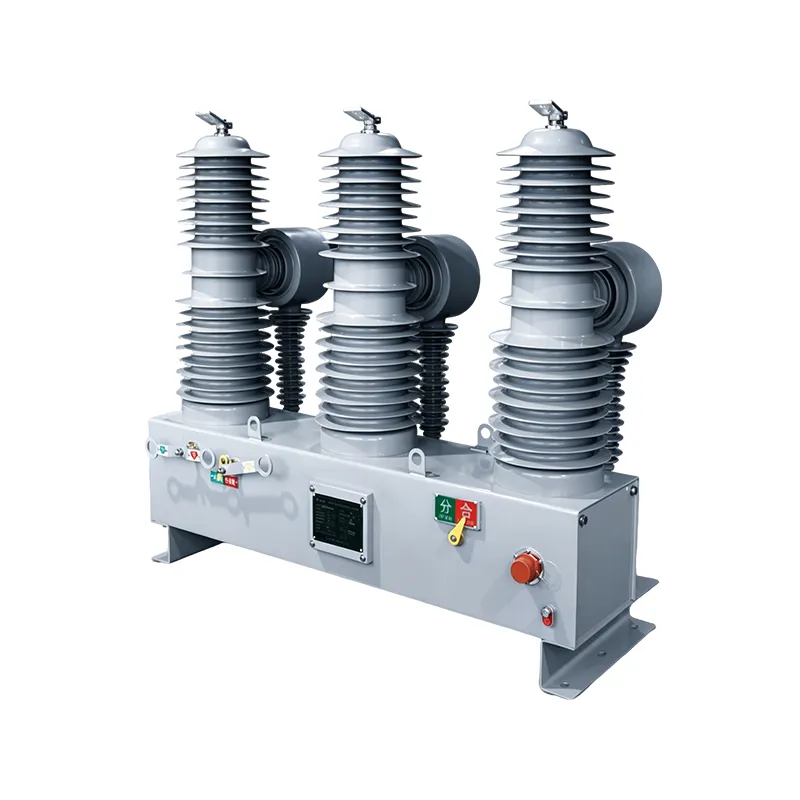
Jubang’s ZW32-40.5 outdoor pole-mounted VCB uses a pillar structure with integrated primary/secondary components (vacuum breaker, isolator, VT, CT, FTU option). Published ratings include 40.5 kV rated voltage, 630–1600 A rated current, 20–31.5 kA short-circuit breaking current, mechanical life 10,000 operations, and partial discharge ≤ 20 pC—see the product page for the full parameter table.
ZW32-40.5 Outdoor Pole Mounted VCB (product photo).
Need help matching voltage, kA, and automation to your single-line diagram? Contact Jubang with your fault study, preferred mechanism, and environmental class.
FAQ
What is an outdoor vacuum circuit breaker used for?
It protects and switches medium-voltage overhead feeders—clearing faults, sectionalizing lines, and supporting automation on outdoor distribution networks.
What voltage classes are common for pole-mounted VCBs?
12 kV is the most common global distribution class; 24 kV and 40.5 kV (35 kV systems) appear on higher-voltage collectors and substation outgoing lines.
How do I size short-circuit breaking capacity?
Calculate or obtain the maximum prospective short-circuit current at the installation point; select a VCB whose rated breaking current exceeds that value with an appropriate safety margin per your utility or internal standard.
When should I choose permanent magnet instead of spring operation?
Choose permanent magnet mechanisms when switching frequency is high, when smart-grid controllers demand long mechanical life, or when reduced holding energy is valued.
Do I need an FTU on every outdoor VCB?
No. Manual or locally operated breakers suffice for simple feeders. Add an FTU when you need remote control, SCADA, fault recording, or automated sectionalizing.
Can outdoor VCBs replace indoor switchgear breakers?
Not directly—they are different product categories. Use outdoor VCBs for pole/structure installation; use indoor breakers inside metal-clad switchgear cubicles.
What environmental factors most affect outdoor VCB life?
Pollution level, humidity, UV exposure, salt fog, and temperature range drive insulator selection, sealing, and sometimes derating—document them in your specification.
References
IEC 62271-100 — High-voltage alternating-current circuit-breakers (framework for rated parameters and tests).
IEEE Standards Association — C37 series circuit breaker standards used in North American utility practice.
Products are exported to more than 100 countries and regions such as Africa, the Middle East, and the United Kingdom and Europe. It is a leading manufacturer of power distribution equipment in China.

 JUBANG