From transformers and switchgear to ring main units, substations, circuit breakers and smart components, Jubang provides integrated product support for power distribution projects.
Discover Jubang’s strengths in technology R&D, quality testing and smart manufacturing, supporting reliable electrical equipment and efficient power distribution solutions for global customers.
From technical consultation and OEM/ODM customization to EPC support, smart O&M, delivery documentation and after-sales service, Jubang supports your project at every stage.
Explore Jubang Group’s development history, intelligent manufacturing base, R&D platforms, CNAS-accredited laboratory and global project service capabilities.
How Much Does a Transformer Cost? Compare Quotes on the Same Scope
Release Time: 2026-11-06
How much does a transformer cost? For an industrial power-distribution project, the useful answer is a quotation for a defined electrical duty and delivery scope. An equipment-only price and an installed-project price are different amounts, even when both describe the same rated capacity.
Without the transformer specification, supply boundary and site requirements, a generic price range cannot establish a project budget. The practical route is to define those inputs, ask suppliers to identify exclusions and compare offers on the same basis. Operating losses can then be evaluated separately as part of ownership cost.
Define the transformer before asking for its price
Rated capacity is a starting point, not a complete specification. The enquiry also needs the high- and low-voltage ratings, phase arrangement, frequency, tapping requirements and connection information. The offered construction and operating conditions must describe the same project duty.
For example, the ordering section for JUBANG’s 6–10 kV oil-immersed power transformer requests the model, capacity, high- and low-voltage values, high-voltage tapping range, phase number, frequency and vector group. It also asks buyers to identify special service conditions during enquiry and ordering.
These fields give the supplier something specific to price. A change to the duty or offered construction should remain visible as a technical deviation, rather than being treated as a simple discount on an otherwise identical item.
How much does a transformer cost at each scope boundary?
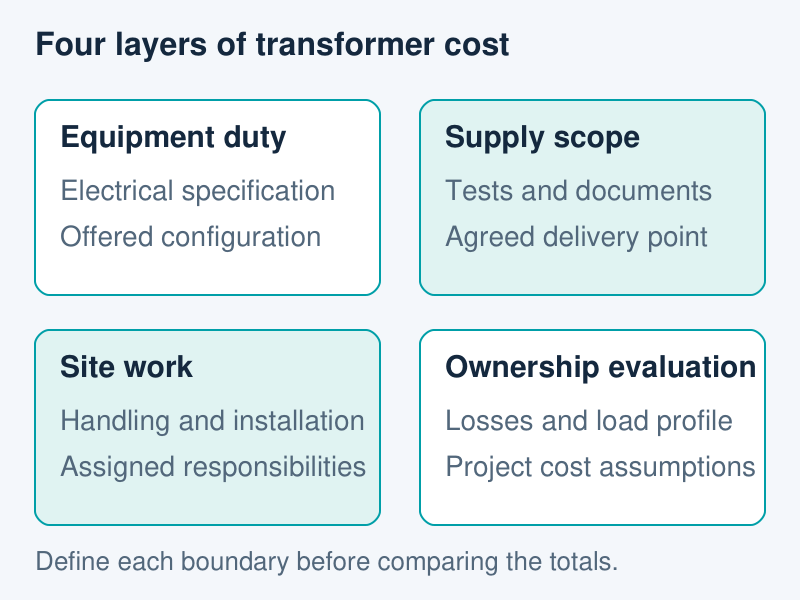
A workable comparison distinguishes the equipment, the supplier’s agreed scope, the work needed at site and the future cost of operation. These layers answer different questions. Combining them too early makes it hard to see whether a lower total reflects a commercial saving or a missing responsibility.
Use separate boundaries for equipment, supply scope, site work and ownership evaluation. The graphic contains no market price estimates.
The equipment layer establishes what is being offered. The supply layer records the agreed tests, documents and delivery point. The site layer assigns handling and installation responsibilities. Ownership evaluation considers the operating consequences under the project’s own assumptions.
A quotation worksheet that exposes missing scope
For each offer, mark the following rows as included, excluded or requiring clarification. Record the document or quotation clause supporting the answer. An empty cell should remain unresolved; it should not silently become zero cost.
Comparison row
What to record for each supplier
Question if unclear
Electrical duty and configuration
The same specification revision and every offered deviation
Is this the equipment duty requested?
Accessories and interfaces
The agreed items and connection boundaries
Which items must another party provide?
Tests and documentation
Included reports, drawings and any separately priced requirements
Does the quoted documentation meet the project request?
Packing and delivery
Packing scope, delivery point and responsibility for transport arrangements
Where does the supplier’s delivery responsibility end?
Site handling and installation
The responsible party and any separately quoted work
Who arranges unloading, positioning and installation?
Commercial basis
Currency, applicable charges, payment terms and quotation validity
Are the compared totals calculated on the same basis?
Delivery commitment
The stated lead-time basis, dependencies and agreed delivery milestone
Which approvals or inputs start the delivery period?
This worksheet does not assume that every supplier provides every service. Its purpose is to make responsibility visible. Where the purchaser must obtain an excluded service elsewhere, that amount belongs in the project comparison once a supported estimate or offer is available.
Equipment cost is different from installed cost
An equipment quotation can be complete within its own boundary while leaving substantial project work outside it. The buyer should identify that boundary before interpreting the total. “Delivered” still needs an agreed delivery point; it does not, by itself, answer who positions or installs the transformer.
The site team should therefore review access, handling and installation responsibilities alongside the commercial offer. This is a scope review, not an instruction to carry out the work. The resulting allowances should come from the parties responsible for the actual site conditions.
A clear comparison retains separate equipment and project totals. That makes later changes easier to understand. If the delivery point changes, the buyer can revisit the delivery row without pretending that the electrical equipment price itself has changed by the same amount.
Include losses in a separate ownership evaluation
The purchase price does not describe the full economic effect of operating a transformer. United for Efficiency’s ownership-cost approach includes the value of future losses in the purchasing decision. ENERGY STAR’s distribution-transformer buying resource likewise connects cost effectiveness with loading conditions and the applicable equipment scope.
For a project comparison, request the relevant loss data and its stated conditions. Use a common load profile and common economic assumptions when evaluating the alternatives. A result calculated for one operating pattern should not be transferred to another installation as a universal saving or payback period.
Keep that evaluation visible beside the initial purchase comparison. The technically acceptable offer with the lowest equipment price and the offer with the lowest evaluated ownership cost need not be selected by the same calculation. The purchaser must decide which basis the tender will use.
Obtain a usable offer and keep it current
A useful enquiry combines the electrical input sheet, required configuration, tests and documents, delivery boundary and site responsibility schedule. Suppliers can then price a defined scope and identify the information still needed. Technical deviations should be resolved before the final commercial comparison.
Quotation validity and delivery commitments also need direct confirmation. DOE’s distribution-transformer work discusses supply-chain constraints, but a general industry statement cannot establish this project’s delivery time or a supplier’s current price.
The final comparison should therefore show the accepted technical basis, normalized supply and site scope, current commercial terms and separate ownership evaluation. Those records turn a broad question about transformer cost into an offer the project team can review and act on.
Products are exported to more than 100 countries and regions such as Africa, the Middle East, and the United Kingdom and Europe. It is a leading manufacturer of power distribution equipment in China.

 JUBANG